SPEECHES
MESSAGES
INAUGURAL
CEREMONY
CLOSING
FUNCTION
|
Glimpses
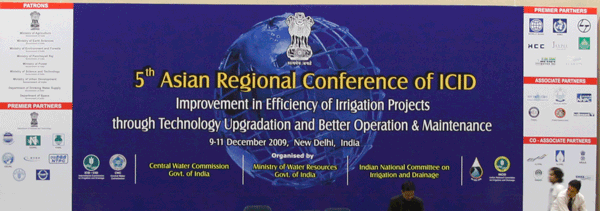
of 60th IEC Meeting & 5th Asian Regional Conference
|
 |
 |
 |
|
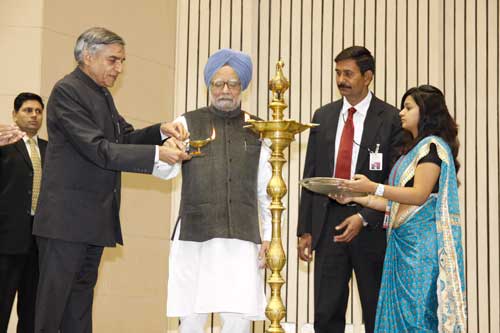
Hon'ble
Prime Minister Dr. Manmohan Singh and Hon'ble Union Minister for Parliamentary
Affairs and Water Resources Shri Pawan Kumar Bansal inaugurating the "60th
IEC Meeting and 5th Asian Regional Conference"
|
Hon'ble
Union Minister of Water Resources Mr. Pawan Kumar Bansal lighting the
lamp
|
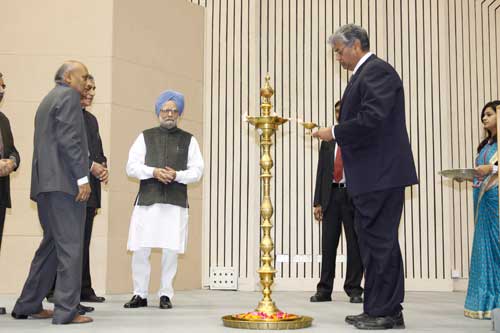
President
Chandra A. Madramootoo lighting the lamp
|
 |
 |
 |
|
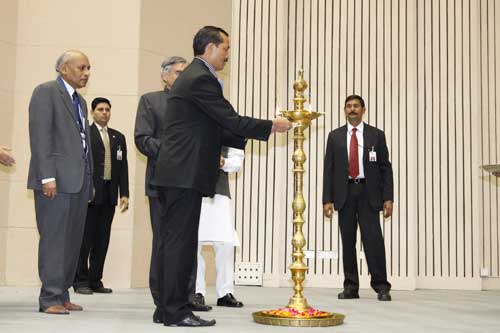
Hon'ble
Minister of State for Water Resources Mr. Vincent H. Pala lighting the
lamp
|
On
the dais (L to R) : President Chandra Madramootoo, Mr. U.N. Panjiar, Secretary
of Ministry of Water Resources, Mr. Pawan Kumar Bansal, Hon'ble Union
Minister of Water Resources, Hon'ble Prime Minister Dr. Manmohan Singh,
Mr. Vincent H. Pala, Hon'ble Minister of State for Water Resources, Mr.
A.K. Bajaj, Chairman, Central Water Commission / Indian National Committee
of ICID, and Er. M. Gopalakrishnan, Secretary General, ICID
|
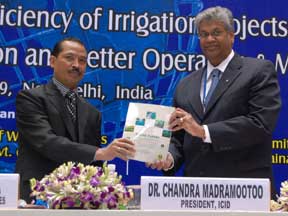
Hon'ble
Minister of State for Water Resources Mr. Vincent H. Pala and President
Chandra Madramootoo releasing a publication
|
 |
 |
 |
|
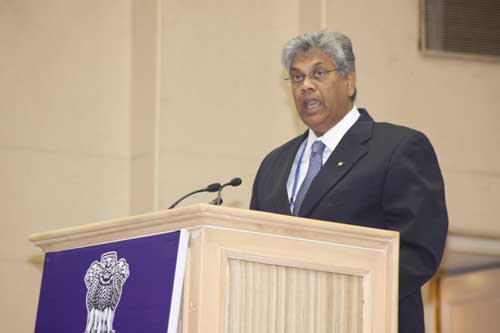
President
Chandra addressing the gathering
|
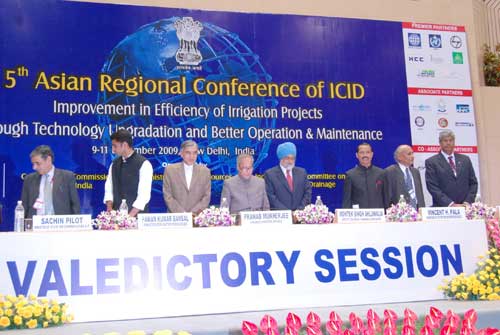
On
the dais (L to R) : Mr. A.K. Bajaj, Chairman, Central Water Commission
/ Indian National Committee of ICID, Mr. Sachin Pilot, Hon'ble Minister
of State for Communications and Information Technology, Mr. Pawan Kumar
Bansal, Hon'ble Union Minister of Water Resources, Dr. Pranab Mukherjee,
Hon'ble Finance Minister, Mr. Montek Singh Ahluwalia, Hon'ble Deputy Chairman
Planning Commission, Mr. Vincent H. Pala, Hon'ble Minister of State for
Water Resources, Mr. U.N. Panjiar, Secretary of Ministry of Water Resources,
and President Chandra Madramootoo
|
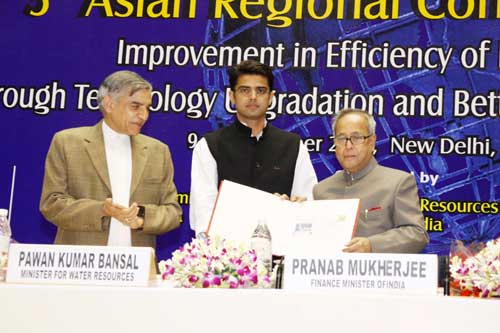
Mr.
Sachin Pilot, Hon'ble Minister of State for Communications and Information
Technology releasing Special Cover in the presence of Mr. Pawan Kumar
Bansal, Hon'ble Union Minister of Water Resources and Dr. Pranab Mukherjee,
Hon'ble Finance Minister
|
 |
 |
|
|
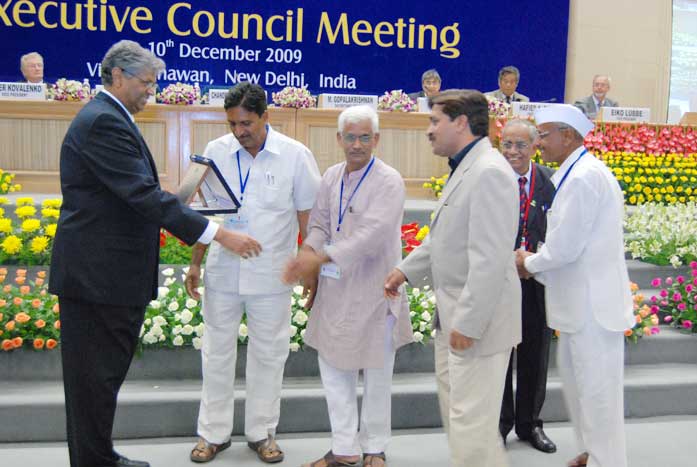
Shahaji
Manikrao Somawanshi, Bharat Kawale and Sanjay Madhukar Belsare, India,
receiving award from President Chandra Madramootoo
|
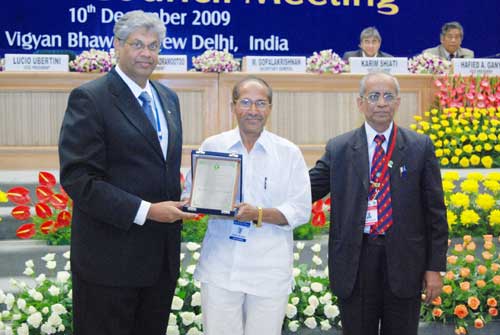
Mr.
Arvind Narayanrao Nalkande (India) receiving Special Recognition from
President Chandra Madramootoo for his initiative on "Rainwater Conservation
through Natural Cracks in Deep Black Soils"
|
| Hon'ble
Prime Minister Dr. Manmohan Singh Inaugurates the 60th IEC Meeting and 5th
Asian Regional Conference 10 December 2009, New Delhi, India
|
| “I
am very happy to be present here to inaugurate the 5th Asian Regional Conference
on “Improvement in Efficiency of Irrigation Projects through Technology
Upgradation and Better Operation & Maintenance.”
It has been said that just as the conflicts of the 20th century were often over the sharing of scarce petroleum resources, those of the 21st century will probably be over the sharing of water. Some estimates suggest that world food demand could double in the next two decades. That will translate into a huge demand for water. Further stress on scarce water resources will be caused by population growth, the majority of which will be dependent on agriculture; industry and will lead to urbanization. Nowhere are these challenges more pressing than in Asia. The spectre of climate change will also have an unpredictable consequence on the water regime. Various studies point towards its adverse impact on the hydrologic cycle that could result in the intensification of both temporal and spatial variations in precipitation. In our country, we are already struggling every year with floods in one part of the country and droughts in other parts of our country. This year, we had severe floods in Karnataka, Andhra Pradesh and elsewhere. At the same time around 300 districts of the country were declared as being drought affected. These imbalances will only intensify with climatic distortions that are now on the horizon. Moreover, there are concerns that climate change may also adversely impact on ground water table and its quality, affecting thereby productivity of the cropping systems. The challenge of managing our water resources in a rational and sustainable manner will thus require action on many fronts and coordination across different sectors of the economy. In India, we have tried to address these complex inter-relationships through the formulation of a National Water Mission, which is one of the eight national missions that are part of our National Action Plan on Climate Change launched recently by the Government of India. The main objective of our “National Water Mission” is integrated water resource management by conserving water, minimizing wastage and ensuring its more equitable distribution both across and within various states of our union. Some of the key action areas of the “National Water Mission” are: Placing of a comprehensive water data base in the public domain and assessment of the impact of climate change on water resources; Promotion of citizen and State actions for water conservation, augmentation and preservation; Focused attention to over-exploited areas; Increasing water use efficiency by at least 20%; and, Promotion of basin level integrated water resource management. The Water Mission will seek to develop new regulatory structures, combined with appropriate entitlements and pricing of water. It will seek to optimize the efficiency of existing irrigation systems. Incentive structures will be designed to promote water-neutral or water positive technologies, recharging of underground water sources and adoption of large- scale irrigation programmes that rely on sprinklers, drip irrigation and ridge and furrow irrigation. An expansion of irrigation and improvement in irrigation efficiency are thus key not only to improving agricultural productivity but also to our strategy for sustainable water use. There has to be a greater synergy between our agricultural policies and our water policies with a view to securing food supply, especially to the poor and vulnerable sections of the population, through more efficient and sustainable use of scarce water resources. The target of doubling the annual rate of growth of agriculture in India to 4% during the Eleventh Plan Period of 2007-2012 is a top priority for our government. To achieve this, we are sharply increasing public investment in agriculture. The most important area for investment in agriculture relates to the provision of water and its most efficient use. In fact, we hope to be able to add about 16 million hectares to the irrigated area during the Eleventh Five Year Plan. But, an assessment of the irrigation system in India indicates that efficiencies of surface water systems can be improved from the present level of 35 to 40% to about 60% and that of groundwater systems from the existing 65% to about 75%. Similar situations prevail in most developing countries in Asia and we have a great deal to learn from each others experience. Utilization of created irrigation potential is another crucial issue. In India only about 84% of the created irrigation potential has been utilized thus far. Efficient use of crop water can increase the gross irrigated area, either by increasing the irrigated cropped area or the intensity of irrigation. All these options have to be explored and collaboration in research among countries represented here shall be a very important, fruitful collaborative exercise to improve the efficiency of water and promote its sustainable use. Therefore, the subject of your deliberations today has vital importance for countries like India that are investing heavily in irrigation schemes. We look forward to the outcome of your deliberations today that could, I hope that will make a practical contribution to the adoption of best practices in the irrigation systems in India and elsewhere in Asia. We need to increase investment in agricultural technologies, particularly those related to improved crop practices, water savings, design of storage structures & more efficient farm implements. The first Green Revolution came due to innovations developed in the public sector. The second Green Revolution may well come from technologies developed in the private sector. It is therefore essential that private investment and innovation be incorporated within a broader vision and strategy of development in the agriculture and water sectors. It is equally important that developed technologies reach the farmers particularly the poorest farmers. I am very happy that the Ministry of Water Resources has launched a “Farmers’ Participatory Action Research Programme” through Agriculture Universities and Agriculture Research Institutes with a view to demonstrate available technologies for increasing productivity and profitability of agriculture. Such programmes need to be expanded. I would like to emphasize that water-related issues need to be addressed with the full involvement of the local communities and take into account specific local conditions and concerns. Farmers as principal stakeholders should be consulted in any agricultural water management initiatives. Women play a key role in food production activities in a large number of countries. Therefore, a special effort should be made to involve women in process of decision-making. I wish to conclude by saying that we should work together, learn from each other and harness all our scarce resources to give substance to the slogan “More Crop and Income per Drop”. I wish your Conference all success.” [Source : Prime Minister's Office] |
| Prof. Chandra A. Madramootoo, President, ICID |
|
NEW DELHI
Honourable
Prime Minister,
Honourable
Prime Minister, Honourable Ministers of Water and distinguished colleagues,
the mission of ICID, in summary, is to enhance the worldwide supply of
food and fibre, by improving water and land productivity. The FAO estimates
that an additional 100 million people in the world have been deprived
access to adequate food in the past year, as a result of the current food
crisis, and the number of people estimated to be undernourished is over
1 billion. Very startling statistics indeed. This statistic is even more
dramatic when we consider that food production will have to double in
the next 25 years or so, to meet rising population levels. The question
is how will we accomplish this task, given the current drivers of water
scarcity and climate change, which are affecting the sustainability of
our food production system. The recent G8 and G20 summits in L'Aquila,
Italy have therefore rightly placed food security and the water crisis
at the top of the global development agenda. It is my
view that ICID, the largest international organization dedicated to water
for food and fibre production, through its 108 member countries, active
National Committees and committees of experts is best placed to finding
solutions to the problems of water for food security. We will have failed
our children and their children, through our inaction. But I believe that
ICID has made many positive strides to enhance the productivity of irrigated
and drainage lands over the past 6 decades, and I am even more convinced
that, as a collective group of international experts, we have the determination
to make further technical, institutional and social-economic breakthroughs
in the future. We all have
shining examples, in our respective countries, of solid achievements in
the irrigation and drainage sector, which have boosted the food producing
potential of our patrimonial lands. In this regards, by virtue of our
meeting in India, I take this opportunity to congratulate the Government
of India for its significant investments in agriculture and water resources
development over the decades, and its extensive efforts at boosting food
production, in order to satisfy the demands of the poorest of the poor. Honourable
Prime Minister, Honourable Ministers of Water, your achievements in food
security in some of the worlds hardest of climatic extremes are laudable.
In the last 50 years, you have quadrupled food grain production from 50
million tones to over 200 million tones. In light of such accomplishments,
I am sure we will benefit wisely from our deliberations here in your remarkable
country. I thank you most wholeheartedly for welcoming us to India, and specifically wish to thank the Ministry of Water Resources, the Central Water Commission, and the Indian National Committee of ICID for organizing and hosting this excellent set of ICID meetings. Thank you Chandra A. Madramootoo |
| M. Gopalakrishnan, Secretary General, ICID |
 The
Indian National Committee on Irrigation and Drainage (INCID) hosted the
events before you on the theme "Improvement in efficiency of irrigation
projects through technology upgradation and better operation and management".
More than 700 professionals, experts, researchers, policy makers, managers,
donors, development partners, and representatives from national, international
organizations from 40 countries participated in the event. The
Indian National Committee on Irrigation and Drainage (INCID) hosted the
events before you on the theme "Improvement in efficiency of irrigation
projects through technology upgradation and better operation and management".
More than 700 professionals, experts, researchers, policy makers, managers,
donors, development partners, and representatives from national, international
organizations from 40 countries participated in the event.
Global food demand is expected to double over the next 25-30 years. An increase in irrigated area and consequent increase in water withdrawals for food production is therefore imperative. This conference is very much timely in view of the worldwide issue of soaring food prices impacted by global financial turmoil. Many national governments, particularly in emerging and least developed countries would have to put major efforts to achieve the required increase in food production. This global event provided an important platform for discussing issues, experiences, best practices, innovative ideas and challenges in agricultural water management specifically focusing on technological upgradation and improvement of water management in the Asian region. More than 190 technical papers were presented in the Conference covering wide range of technical, institutional, legal issues of irrigation development and management The Conference was inaugurated by Hon'ble Prime Minister of India, Dr. Manmohan Singh, who highlighted the challenge of food demand, climate change, floods and drought requiring integrated approach into resource management to conserve water and ensure equitable distribution of resources, through citizen and State actions. DELHI DECLARATION
In due consideration of the transactions and deliberations in various technical working groups, special sessions, and the Asian Regional Conference it was resolved that:
|
|
MESSAGES
|
| HE Smt. Pratibha Devisingh Patil, President, Republic of India |
 |
| HE M. Hamid Ansari, Vice President, Republic of India |
| Hon'ble Prime Minister Dr. Manmohan Singh |
 |
| Hon'ble Finance Minister Dr. Pranab Mukherjee |
 |
| Hon'ble Minister of Agriculture & Consumer Affairs and Food & Public Distribution Shri Sharad Pawar |
 |
| Hon'ble Minister of Parliamentary Affairs and Water Resources Shri Pawan Kumar Bansal |
 |
| Hon'ble Deputy Chairman Planning Commission Shri Montek Singh Ahluwalia |
 |
| Hon'ble Chief Minister of Haryana, Shri Bhupinder Singh Hooda |
 |
| Hon'ble Chief Minister of Himachal Pradesh, Shri Prem Kumar Dhumal |
 |
| Hon'ble Chief Minister of Madhya Pradesh, Shri Shivraj Singh Chouhan |
 |
| Hon'ble Chief Minister of Maharashtra, Shri Ashok Chavan |
 |
| Hon'ble Chief Minister of Orissa, Shri Naveen Patnaik |
 |
| Hon'ble Chief Minister of Tamil Nadu, Shri M. Karunanidhi |
 |
| Hon'ble Minister of State for Water Resources Shri Vincent H. Pala |
 |
| Shri Umesh Narayan Panjiar, Secretary, Ministry of Water Resources |
 |
| Prof. dr. Chandra A. Madramootoo, President, ICID |
 |
| Shri A.K. Bajaj, Chairman, Central Water Commission |
 |
| M. Gopalakrishnan, Secretary General, ICID |
| The
tradition of creating of water infrastructure in India could be traced back
to the times of ancient scriptures, though the sizeable water diversion
from major rivers like the Cauvery dates back to the Chola Kingdom of the
peninsular India (in the present Tamil Nadu State) dating back to over 1800
years.
India is privileged to host the ICID base after a laudable initiative in 1950, co-opting with 11 other nations with similar enthusiasm. The Central Office, located in the Diplomatic Enclave in New Delhi is in a central enviable area where foreign embassies and missions are located. ICID has now grown as an established global network with a membership of 108 member countries. We are proud to usher in the 60th year in June 2009. The upcoming ICID international council meetings coupled with Asian Regional Conference in December 2009 indeed connote our Diamond Jubilee. With the dominant size of irrigated agriculture in the country, India's concerted efforts are being shifted to increase water productivity as this alone can guarantee the food and feed for the increasing billions of people ensuring nutritional demands besides its livestock population that is as sizeable as its human counts. This year's theme for the regional congress is exactly that. The scope to revamp the traditional systems asks for picking up the best of the state of the art knowledge available, anywhere in the world. And indeed, further improve upon it or tailor it to Indian needs. Irrigation practices are getting revolutionized with the growing pressure on water for various uses and there are interesting lessons to learn from each other and the conference provides ample scope for this to happen. Exhibits by Global Entrepreneurs in the field of modern irrigated agriculture will showcase evolving new technologies to help the developing countries to closely see their relevance in their own settings; there is a dire need to enhance the performance of large scale schemes already developed to yield manifold production while saving water for optimal utilisation. I congratulate the organizers for their thoughtfulness to bring out a souvenir on the occasion. This provides an opportunity not only for irrigated agricultural sector but also other associated water agencies to highlight the impressive strides taking place. We are grateful to INCID's Advisory / Organising / Science and Technology Committees for their efforts to mentor in organizing the 5th Asian Regional Conference befitting the ICID Diamond Jubilee. M. Gopalakrishnan |
 It
gives me great pleasure to welcome you all this morning to the opening
of the 60th International Executive Council meeting of ICID and the 5th
Asian Regional Conference. I am particularly pleased to say how wonderful
it is for us to gather here in Delhi, the home of ICID. For it is here,
some 60 years ago, that our founding fathers gave birth to ICID. And it
is through the gracious goodwill of the Government of India that the premises
of our Central Office have been bequeathed. I therefore take this opportunity,
Honourable Prime Minister, on behalf of all the National Committees and
members of the ICID family, to express my deepest gratitude to the Government
and people of India for their generosity towards ICID over the past six
decades.
It
gives me great pleasure to welcome you all this morning to the opening
of the 60th International Executive Council meeting of ICID and the 5th
Asian Regional Conference. I am particularly pleased to say how wonderful
it is for us to gather here in Delhi, the home of ICID. For it is here,
some 60 years ago, that our founding fathers gave birth to ICID. And it
is through the gracious goodwill of the Government of India that the premises
of our Central Office have been bequeathed. I therefore take this opportunity,
Honourable Prime Minister, on behalf of all the National Committees and
members of the ICID family, to express my deepest gratitude to the Government
and people of India for their generosity towards ICID over the past six
decades.