Irrigation
and Drainage
The Journal of the International Commission on
Irrigation and Drainage
Published
: 5 issues per year, ISSN : 1531-0353
Full print + electronic US$ 468; Full print only, or online only US$ 425;
Personal US$ 320;
Special rates to ICID NCs and Booksellers
 ICID
has for half a century been the main organization for the global dissemination
of experience and new ideas in the quest for the sustainable use and protection
of water and land to meet the world’s increasing demand for food
and fibre. ICID
has for half a century been the main organization for the global dissemination
of experience and new ideas in the quest for the sustainable use and protection
of water and land to meet the world’s increasing demand for food
and fibre.
The ICID Journal ‘Irrigation and Drainage’ is the flagship publication of ICID. The journal is a prestigious, peer-reviewed publication, publishing original papers on scientific, engineering, environmental and socio-economic issues associated with irrigation and drainage. It is a rich resource of reference to professionals, engineers, researchers, university professors and students of irrigation, drainage, and agriculture disciplines. Its management is governed by an International Editorial Board (EB). The Journal is published in five issues per volume by M/s. Wiley-Blackwell Ltd., United Kingdom and is also now available online. The 2013 impact factor was 0.685, with the five year impact factor of 1.10.
As members, all ICID National Committees receive 10 copies of the Journal for distribution among its members, on a complimentary basis preferably on-line, but can also be provided in hard copy. Members of various Working Groups also receive a complimentary copy. Direct Members also receive an on-line complimentary copy.
The Journal can be subscribed online The Journal is published in five issues per volume by M/s. Wiley-Blackwell Ltd., United Kingdom and is also now available online: http://onlinelibrary.wiley.com/journal/10.1002/(ISSN)1531-0361 |
WIF1 - Summary Report
The Summary Report of the First World Irrigation Forum contains a brief outcome of the various sessions, sub-themes, side events, roundtables and panel discussions. This report presents the highlights of the WIF1, benefitting particularly those who could not make it to Mardin. It also contains a DVD with full version of the background papers, keynote addresses, and various papers presented at the Forum.
Download [PDF 9.30 MB] |
Food Security by Optimal Use of Water - Synthesis of Theme 2.2 of the WWF6
ICID jointly with FAO was involved in the preparations of the Thematic Priority 2.2 on ‘Contribute to Food Security
by Optimal Use of Water’ with Dr Pasquale Steduto from FAO as the Coordinator of the Core Group and Prof Bart Schultz, President Honoraire, ICID as Co-coordinator. Under this thematic priority nine targets were identified and debated in various essions including the opening session, a multi-stakeholder panel, and a synthesis session during the Forum to move from “targets” to “solutions”.
[ Download Food Security by Optimal Use of Water - Synthesis of Theme 2.2 of WWF6 (2.62 MB pdf) ] |
CD-ROM on Agriculture Drainage Digest (1983-2013) - Outcome of the ICID Working Group on Drainage (2013)
Working together with various international institutions the Working Group on Drainage (WG-Drainage) of International
Commission on Irrigation and Drainage (ICID) has provided a number of publications dedicated exclusively to various facets of agriculture drainage. The present DVD entitled “Agriculture Drainage Digest (1973-2013)” is another such effort by the WGDrainagethat compiles all the possible publications addressing the theory and practise of drainage in one place and make it easily accessible in electronic format. It is hoped that this DVD will be another gem in the knowledge series brought out by ICID through the activities of its WGs from time to time. |
Climate Change Adaptation for Irrigation and Drainage in Asia – Report of the Asian Regional Task Force for Climate Change
March 2012; Paper bound; 162 pp+ vii; ISBN : 978-81-89610-13-5
Price : ICID Members and Booksellers: US$ 10; Non-ICID Members: US$ 20
The Asian Regional Working Group (ASRWG) organized several workshops and seminars on the subject. It set up an Asian Regional Task Force on Climate Change (ARTF-CC) to study the effects of climate change in the field of irrigation and drainage in Asia. The participating countries were: China, Indian, Indonesia, Iran, Japan, Korea, Malaysia, Nepal, Pakistan, Chinese Taipei, Thailand, and Turkey. The study was carried out in two steps. This status report is based on the outcomes of these deliberations and case studies.
Full Report: http://ppts.icidonline.org/report_asia_cc_1.pdf
http://ppts.icidonline.org/report_asia_cc_2.pdf
Online
Order
|
Towards Sustainable Development of Tidal Areas: Principles and Experiences
by Working Group on Sustainable Development of Tidal Areas (WG-SDTA)
2011, ISBN 978-81-89610-4
Price Non-Member US $400; NCs/Members and Booksellers US$ 200
Tidal areas exist all over the world along the coasts. Generally they are sensitive areas with a high ecological value. Due to their physical conditions and environmental value they are normally left as such and spared from development. However, due to strategic reasons, in many locations there are often tremendous pressures to develop these areas for various types of land uses. Thus, ICID Working Group on Sustainable Development of Tidal Areas (WG-SDTA) held several workshops, seminars and meetings during last decade in order to prepare this publication. The publication presents the principles and guidelines for engineers and the decision makers for sustainable development of tidal areas. The publication is based on experiences from specialists in various densely populated countries, like China, Germany, India, Indonesia, Japan, Korea, Malaysia, Taiwan, the Netherlands and the United Kingdom. The publication is based on three principles: optimal use of land and water resources, disaster prevention, and the preservation of biodiversity for present and future generations.
Online
Order
|
CD-ROM
ICID@60
Prepared in : 2009 by ICID Central Office
Price : Non-Members; NCs/ Members and Book Sellers US$5 (Handling charges)
This CD gives
detailed information about International Commission on Irrigation and
Drainage (ICID) and answers following questions:
• What is ICID?
• Who are its members?
• How it works?
• What is its contribution?
• How it meets challenges?
This handy
computer software can be very useful for persons/ organizations interested
in knowing about ICID and participation in its activities.
Online
Order |
Water
Saving in Agriculture
October
2008; Paper bound; 91 pp+ xii; ISBN : 81-89610-08-2
Price : ICID Members and Booksellers: US$ 20; Non-ICID Members: US$ 40

ICID
instituted 'WatSave Awards' in 1997 to recognize professionals for their
outstanding contribution to water saving in agriculture across the world.
Since its establishment, there has been an overwhelming response and over
135 nominations from ICID national committees were received. So far, 24
awards have been given to the professionals coming from 12 countries across
the world.
Earlier,
a booklet providing primary information about the water saving practices
adopted by some of the ICID member countries was published in 1995. Subsequently,
a comprehensive document "THE WATSAVE SCENARIO" comprising information
received from 27 countries was published in 1997. The document was very
well received not only by ICID member countries but by international organizations,
as well.
This document
is a compilation in a different form. Besides bringing out in a generic
sense selected experts across the world have contributed to enhance its
contents. The case studies of successful water savings from Australia,
Brazil, China, India, Egypt, Korea, Pakistan, South Africa, Spain, Turkmenistan,
and USA are highlighted and as obvious, water saving efforts is more conspicuous
in countries having significant irrigated agriculture. It is hoped that
the innovative ideas and practices captured in this compilation would
enthuse other countries and ICID's mission to spread 'best practices'
would stand accomplished.
This book
will be a rich source of knowledge and reference work providing an inspiration
for those professionals engaged in aspiring 'more and more crop per drop'.
Online
Order |
Report
of ICID Task Force for Least Developed Countries in Asia
August
2008; Paper bound; 146 pp+ vi; ISBN : 81-89610-12-0
Price : ICID Members and Booksellers: US$ 10; Non-ICID Members: US$ 20

Of
the world’s 50 Least Developed Countries (LDCs), 15 are located in
Asia and remaining are in Africa and South America. Development and management
of irrigation, drainage and flood control play a key role in poverty eradication
and increasing the productivity of agriculture in LDCs. ICID in 2003 established
a Task Force for Least Developed Countries in Asia (TF-LDCs-AS) to investigate
the problems and needs of LDCs and to identify the priority issues that
need to be addressed for their development. It was found that the LDCs
are facing problems like – capital shortage, poor governance, limited
capacity to service financial borrowings, inadequate legal systems, and
underdeveloped farmer organizations. This book contains various recommendations
towards promoting irrigation and drainage in LDCs of Asia.
Online
Order
|
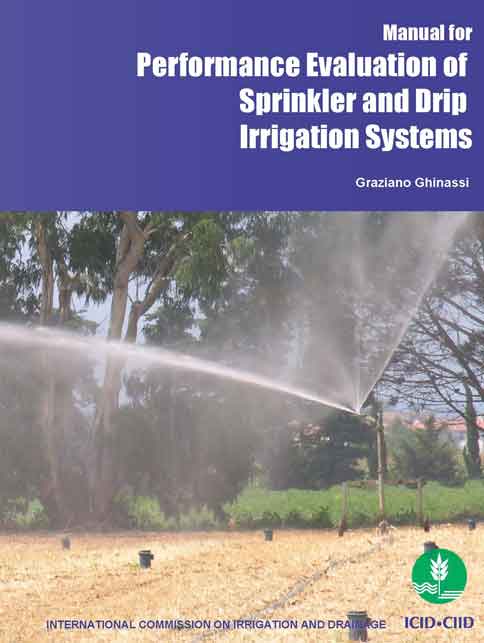
Manual
for Performance Evaluation of Sprinkler and Drip Irrigation Systems in
Different Agro-Climatic Regions of the World
Author
: Graziano
Ghinassi (Italy)
October
2008;
Paper bound; 119 pp+ xvi; ISBN : 81-89610-11-2
Price : ICID Members and Booksellers: US$ 20; Non-ICID Members: US$ 40
Improvement
of on-farm irrigation efficiency is important not only to enhance the
overall irrigation efficiency of the irrigation schemes but also to boost
the crop water productivity. Worldwide, the use of sprinkler and micro
irrigation methods have been steadily increasing in order to cope with
declining water withdrawals to irrigation, better use of other farm inputs
like - seed, fertilizers and chemicals, energy, etc. besides increasing
crop yields. At the same time, these pressurized irrigation technologies
should not be considered as a panacea for improved on-farm water management.
Experience has shown that if these systems are not designed, operated,
and maintained properly, they may not give the expected benefits and even
in some situations may adversely affect the crop growth. It is therefore
essential to carry out periodic diagnostic analysis and performance evaluation
of the pressurized irrigation systems to ensure that they are operating
optimally.
ICID Working
Group on On-Farm Water Management (WG-ON-FARM) has been promoting the
science and art of on-farm technology with a view to improve irrigation
management and optimal use of various resources, and technology transfer
worldwide. Among the pressurized irrigation, micro irrigation technology
is expanding by leaps and bounds. Today about 14% of the total world irrigated
area is equipped with sprinkler and micro irrigation systems. Many new
and innovative products are being produced by the researchers and manufacturers.
This publication 'Manual for Performance Evaluation of Sprinkler and Drip
Irrigation Systems in Different Agro-Climatic Regions of the World' is
the third in its series. The manual is authored by Dr. Graziano Ghinassi,
Member WG-ON-FARM and Researcher, Department of Agricultural and Forest
Engineering, University of Florence, Italy. Dr. Ghinassi has a long and
varied field experience in conducting performance evaluation tests of
different types of sprinkler and micro irrigation systems. Although, there
are many publications on performance evaluation of on-farm irrigation
methods, this manual is different due to its own unique approach. It provides
a comprehensive information both, theoretical and practical; these inter-alia
include appropriate performance indicators, field evaluation techniques
and factors affecting irrigation systems performance etc. Dr. Ghinassi
has touched upon the practical aspects and provided minute details on
various performance indicators and their field testing. The use of several
diagrams/ sketches and field pictures, besides case studies from various
countries enhance the value of the work.
Online
Order
|
CD-ROM
version of Task Force Reports - An ICID Input to WWF 3 and 4
September 2007
Price : ICID Members and Booksellers: US$ 5; Non-ICID Members: US$ 10
As a contribution
to the Sector Vision on Water for Food and Rural Development for the Second
World Water Forum at The Hague in March 2000, ICID presented a draft Strategy
for Implementing the Sector Vision. This Strategy document was further
improved, updated and finalised through eight regional visions, 43 country
reports and several deliberations within ICID. The Document was approved
by the International Executive Council (IEC). Based on the recommendation
emanating from the Strategy Theme 'Policy' presented at the 50th IEC meeting
in Cape Town, South Africa in 2000 and the decision of IEC to provide
ICID inputs to the Third World Water Forum to be held in Kyoto, Japan
in 2003, the following special Task Forces were set up:
TF1 : To Guide ICID Preparation of ICID Inputs for the Third World Water Forum
TF2 : To Develop Position Paper on Global Issues related to Food
Production, Security and Food Trade
TF3 : To Prepare ICID Position Paper on Socio-Economic Sustainability
of Services provided by Irrigation, Drainage and Flood Schemes in Water
Resources Sector.
At the 51st
IEC held in Seoul, Korea in 2001, the following two more Task Forces were
set up:
TF4 : Benchmarking of Irrigation and Drainage Projects
TF5 : Promoting Appropriate Decision-Making Procedures for New
Dams, particularly for Irrigation, Drainage and Flood Management
All the above
TFs completed their assigned tasks by 2004.
This CD-ROM
presents the findings of the Task Forces in the form of reports produced
by them.
Online
Order
|
Micro
Irrigation in Arid and Semi-Arid Regions - Guidelines for Planning and
Design
Author
: Moshe
Sne (Israel)
September 2006; Paper bound; 126 pp+ ix; ISBN : 81-89610-09-0
Price : ICID Members and Booksellers: US$ 30; Non-ICID Members: US$ 60
Over
the past three decades, micro irrigation as a technology has matured into
a reliable water and fertigation management system for crop production.
The usage of micro irrigation is increasing world over, especially in
arid and semi-arid regions as an effective water conservation and demand
management measure to cope up with the increasing scarcity of water in
agriculture. The micro irrigated area grew gradually from 1.1 million
ha in 1986 to about 3.0 million ha in 2000. Today, the micro irrigation
is practiced in more than 70 countries covering an area of over 6 million
ha showing the doubling of area just in the last six years.
Based on
the initiative of Working Group on On-Farm Irrigation Systems (WG-ON-FARM),
the Central Office ICID in collaboration with the Israel National Committee
on Irrigation and Drainage (ISCID) brought out these guidelines.
The book
contains 14 chapters and provides information on the latest developments
in micro irrigation system components, practical aspects of water treatment
and filtration, fertigation, monitoring and control, and maintenance of
micro irrigation systems. Israel has been a pioneering country in the
field of pressurized irrigation technology, especially in micro irrigation.
Mr. Moshe Sne, the author of the book has a vast experience in the planning,
designing and implementation of micro irrigation systems. The book has
a sizeable illustrations and tables.
The step
by step procedure of planning and design of micro irrigation system for
variety of crops are given in a scientific manner in a lucid language
with some practical examples.
This guideline
will be a valuable reference book for irrigation engineers, practising
professionals in water management, students, farmers, manufacturers and
all those dealing with the subject of micro irrigation.
Online
Order
|
Planning
and Designing of Micro-Irrigation in Humid Regions
Author
: Masaharu
Kuroda (Japan)
August 2005; Paper bound; 32 pp+ viii; ISBN : 81-89610-01-5
Price : ICID Members and Booksellers: US$ 10; Non-ICID Members: US$ 20

Rainfall
does not always fall uniformly, even in humid regions. Rainfall events
have large seasonal or irregular fluctuations. Upland irrigation, therefore
is necessary in humid regions in order to keep the soil moisture at desired
level. Intensive cultivation is essential in order to harvest high quality
fruits and vegetables, and careful water application via irrigation is
very essential.
The publication
deals with all aspects of micro irrigation system like planning and design
taking into consideration the special characteristics viz., climate, crops,
farming systems and cropping patterns, etc. pertaining to the project
area. It summarizes information about ‘on-farm micro irrigation’
from published manuals and guidelines dealing with upland irrigation in
Japan, with particular reference to humid areas. It provides information
on computation
of consumptive use/crop water requirements in humid climate and different
layouts of micro irrigation with special reference to Japanese situation.
For demonstrative
purposes, the author has provided a detailed mathematical analysis of
planning and designing of a farm pond.
Online
Order
|
Manual
on Planning of Structural Approaches to Flood Management
Author
: J.
van Duivendijk (The Netherlands)
March
2005; Paper bound; 114 pp+ X; ISBN : 81-85068-89-5
Price : ICID Members and Booksellers: US$ 20; Non-ICID Members: US$ 40
Flood
Management (or flood risk management) concerns all actions related to
the control of floods, the mitigation of flooding and, after such flood
control and mitigative measures have been implemented, the management
of the residual risk of flooding. In order to decide on an optimum solution
of flooding problems, it is necessary to know the extent of damage caused
by floods of different magnitudes/probabilities. A logical method of assessing
such damage for use in the selection of a flood protection system is presented
in this Manual.
An effort
has been made to formulate recommendations for the application of a certain
return period as a function of the considerations mentioned in the Manual.
Advantages and disadvantages of a standard level of protection have been
mentioned. Reasons for adopting a certain level of protection for a certain
area (such as loss of human life), has been discussed including related
political, economic or psychological considerations.
Further,
the use of hydrodynamic mathematical models of the deterministic type
for carrying out flood management has been described. The purpose and
effectiveness of certain mathematical models for understanding the flooding
phenomenon for studying and testing flood control measures and, finally,
for calculating various flood parameters has also been described.
In all, this
Manual covers all management strategies for flood mitigation involving
structural approaches and complements ICID’s Manual on Non-Structural
Approaches to Flood Management.
Online
Order
|
Application
of Geosynthetics in Irrigation and Drainage Projects
Author
: Herve Plusquellec (USA)
September
2004; Paper bound; 79pp; ISBN: 81-85068-88-7
Price: ICID members and Booksellers: US$15; Non-ICID members : US$30
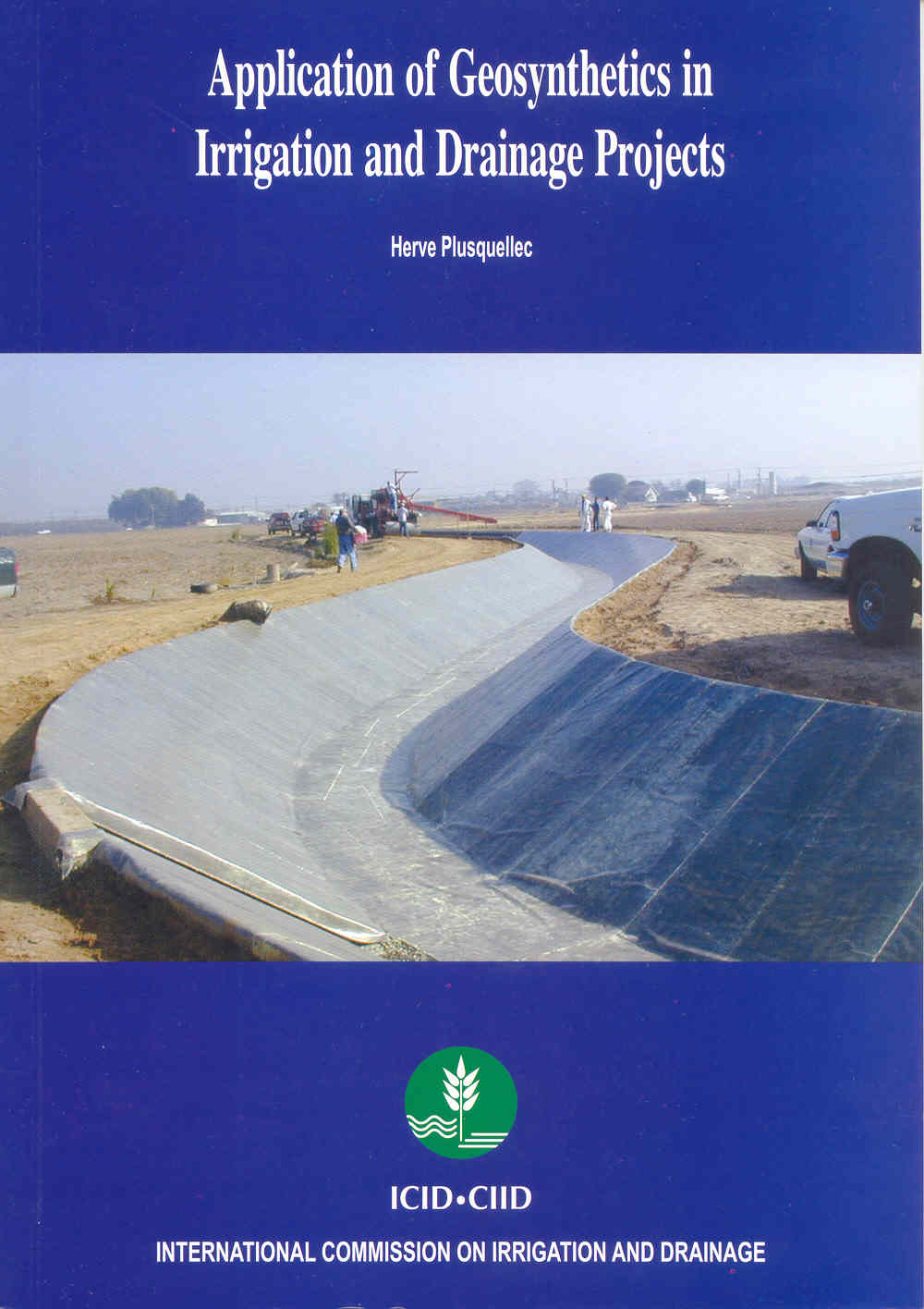
Conservation
of water resources is becoming increasingly important as the demand for
water from agriculture, domestic and industrial sectors and ecosystem
rises rapidly and the new sources of supply become scarcer. There is increasing
evidence that conventional methods using hard/rigid surfaces to reduce
seepage losses from irrigation canals are not performing as expected.
Drainage problems are often amplified as a result of excessive seepage
losses from canals. In this context, adoption of innovative construction
techniques in irrigation and drainage projects with the use of geosynthetics
is an important step forward.
The generic term “Geosynthetics” is used to designate construction
materials produced by the chemical and textile industry for use in geotechnical
engineering. The geosynthetics industry, during the last three decades
has developed a wide range of materials that are useful in the development
of irrigation and drainage projects, especially for controlling seepage
and erosion. Geosynthetics now provide unprecedented possibilities for
design and construction of low embankment dams, cost effective solutions
for slope and channel protection, and long term solution for control of
seepage losses from reservoirs and channels. It is now possible to find
a geosynthetic material that meets project specifications and has durability
consistent with the project design life, even under extreme climatic conditions.
Experience of application of geo-synthetics in several countries has amply
proved their superiority over the traditional hard/ rigid lining materials
in respect of quality, saving in cost and time of installation, especially
for irrigation canals in operation.
The book provides information on the wide range of geosynthetics and their
potential application to irrigation and drainage projects. The controversial
issue of lining or not irrrigation canals and the design and construction
issues of lining with conventional hard materials or with the use of geosynthetics
is discussed. Special attention is given to the techniques to line existing
canals with minimum interruption of irrigation service with the use of
geocells, concrete-filled mattresses or field fabricated geocomposite
for example. Finally the book discusses the selection of geomembranes
based on the technical service requirements-and not purely on cost considerations-and
discusses the two main procurement methods based either on material-specific
or performance-specifications.
The book
contains more than 20 coloured photographs of actual installations and
use of geosynthetics in various irrigation projects world over. The book
provides a list of international organizations involved in the development
of geosynthetics and providing services to the industry and to their clients,
model of performance-type technical specifications for the supply and
installation of geomembranes, and technical specifications for the supply
of laboratory equipments.
This book
is of great interest to various agencies dealing with execution of irrigation
and drainage projects, irrigation and drainage engineers, planners, and
financing and research institutions. It is hoped that it will stimulate
consideration of the use of geosynthetics in upgrading existing irrigation
systems in need of rehabilitation and modernization. The book will be
useful, particularly for developing countries where its application is
not keeping pace with the development of geosynthetics industry but massive
investments are taking place for modernization/rehabilitation of irrigation
and drainage systems.
ICID has
brought out this book to keep the professionals abreast with the advances
in the rapidly changing and expanding geosynthetics technology. Mr. Plusquellec,
author of the book, has compiled available information on different types
of geosynthetic materials and provided practical tips for selection, installation,
procurement and quality control to facilitate safe design and construction
of structures incorporating geosynthetics. Mr. Plusquellec has extensive
field experience in design, management and performance assessment of irrigation
projects world over during his tenure with the World Bank. He has direct
experience in the use of geosynthetics in large irrigation projects in
Middle East, South Asia and China. Geosynthetics experts Mr. Michael Snell,
UK and Mr. Peter Stevenson, Secretary, International Geosynthetics Society
(IGS) have reviewed the document and Prof. J.P. Giroud, President Hon.,
IGS has provided prologue to the publication.
Online
Order
|
The
Indus Basin
History of Irrigation, Drainage and Flood Management
Edited
by H. Fahlbusch, Bart Schultz and C.D. Thatte
February
2004, ISBN : 81-85068-77-1
Price : Non-Member US$140; NCs/Members and Booksellers US$70
This
publication provides a historical picture of the past and present of the
Indus Basin covering an area of 1.15 million sq km. The mighty Indus river,
originating at a height of 5,494 +MSL near Mansarovar lake in Tibet in
the Himalayas, flows for 2,880 km to meet the Arabian Sea. This is the
sixth largest river of the world whose agriculture-centred civilization
belongs to the fifth millennium BC, only second to that of Euphrates/Tigris
of 7th millennium, but older than Nile’s of 4th millennium, or that
of Huang Ho (Yellow river) of 2nd millennium. In terms of water carried,
the Indus flow is three times Nile’s, ten times Colorado’s and
equal to Columbia’s.
Agriculture,
like in other contemporary civilizations, was the backbone of Indus too.
Megasthenes and Fa-Hsien, as also the modern archaeologists and historians
have all eloquently described the magnificence of this basin, its agriculture
and artistic skill of its people as evidenced from excavated pottery,
stone work, sculpture and seals. Kalibangan excavations in present western
Rajasthan (2450-2300 BC) shows a ploughed field, the first site of this
nature in the world. It shows grid of furrows, placed about 30 cm apart
running east-west and other spaced about 190 cm apart running north-south,
a pattern remarkably similar to the one practiced even now.The great
bath at Mohenjo-Daro deployed an ingenious hydraulic system. The level
of urbanization was seemingly far more advanced than in other contemporary
civilizations. Cities were divided into the citadel and residential areas
and the streets ran straight, following a grid iron pattern. The houses
were built of burnt bricks with remarkable drainage system using ceramic
drain pipes, covered sewers and vaulted sub-terranean conduits. Like all
the tropical monsoon basins, the Indus Basin has been experiencing floods
of varying magnitudes from time immemorial. The archaeological explorations
in search of Indus Valley Civilization have revealed the existence of
embankments on river banks to protect cities.
The founder
of Mughal dynasty in India in the early 16th century, Babur, gave in his
memoirs called ‘Baburnamah’ a vivid description of natural history
and prevalent modes of irrigation practices in India at that time. The
fields were irrigated by transporting water through inundation canals
making use of rivers in spate and by sailaba (flooding) irrigation. The
dug wells were also put to use to draw water for irrigation. The existence
of Karezs (underground water channels) and lifting devices called charas,
shaduf or dhenkli, rati and Persian wheels indicates extensive use of
groundwater for irrigation. The early stone dams, called Gabar Bunds,
and terrace dams, called Kach Bunds, have been found in the arid regions
of Sindh and Balochistan, delta area and south-western part of Sindh.
The Gabar Bunds captured and stored annual runoff from surrounding mountains
to be made available to tracts under cultivation.
With the
introduction of canal irrigation in the basin during British rule, necessary
legal framework to bring about orderly use and regulation of water also
got built-up and levy system of cess/toll/dues on some canals for irrigation/navigation
was started. By about 1880, the old settled regions of the Punjab comprising
lands carrying proprietory rights had been provided with irrigation facilities
either by constructing new canals or by remodelling and restoration of
old canals. Warabandi (rotational) system of water distribution amongst
users is the hallmark of Indus basin that has worked well for centuries.
Various types of warabandi, such as bhaichara (brotherhood), khatewar
(farmers’ title wise), nakkewar (farm inlet wise) etc. are still
being practised with astounding success. At places, the overuse of irrigation
water has given rise to the twin problems of waterlogging and salinity
affecting productivity. Efforts are on to tackle the menace.
The basin
is home to an internationally acclaimed water sharing accord, called the
Indus Water Treaty, signed between India and Pakistan in 1960 that has
survived the test of time. The large infrastructure development in the
basin comprising dams, barrages, canals, minors etc. has helped in transformation
of the basin as a bread basket for the two countries. Constantly improving
command area development and management, besides on-farm developmental
works, have imparted better productivity in the region. The irrigation
system in the Indus basin is today perhaps world’s largest integrated
and physically contiguous system, in a densely populated region that crossed
a population figure of 196 million in 1991.
Online
Order
|
Danube
Valley
History of Irrigation, Drainage and Flood Control
Edited
by G. Csekö and L. Hayde
January 2004, ISBN : 81-85068-85-2
Price : Non-Member US$150; NCs/Members and Booksellers US$75

River
Danube, also called variously as Donau, Dunaj, Duna, Dunav or Dunarea
in different countries, originates in the high Schwarzwald massif and
flows for 2,857 km across Europe to meet the Black Sea and traverses on
its way through glacier-covered mountains, karst formations, forests,
highlands and uplands, plateaus with deeply carved river valleys and plains
as an international waterway connecting nine (previously seven) countries.
With its 817,000 sq km catchment area, it is ranked 25th in the world
and length- and discharge wise the second largest river (after Volga)
in Europe, crossing 22 geographical latitudes joining nine countries -
Austria, Bulgaria, erstwhile Czechoslovakia (covering Bohemia and Slovakia
since 1993), Germany, Hungary, Romania and former Yugoslavia (covering
Croatia and Serbia since 1989).
The rich,
fertile basin has been the centre of attraction for the trading nations,
as also for the conquerors and nomads since the earliest times. In the
8th to 7th century BC, Phenicians, Egyptians, and Greeks entered the Danube
estuary initiating trade contacts with the local population. In the 6th
century BC, the Persian monarch, Darius the First, attempted to occupy
the territories adjacent to lower Danube basin. Alexander the Great of
Macedonia attempted its occupation in 334 BC. In the first century AD,
the upper Danube formed a part of Roman Empire. In the years 101 - 106
AD, the Roman Emperor Traianus defeated the Dacian tribes who were settled
in the lower Danube basin. Up to the year 271 AD when Romans retreated,
water use for agriculture had started. During 6th to 17th century, irrigation
techniques and water mills saw a marked development, though complex water
capturing projects for new agricultural lands could be possible only towards
the end of 19th century. The earliest measures of hydraulic engineering
on the Danube have been recorded by or attributed to the monasteries of
Niederaltelch (founded by monks in 731) and Oberalteich.
Meadow irrigation
in the idyllic tributary valley of the Lauchert in Germany goes back to
16th century. The oldest known document on irrigation regulation originates
from the year 1584. Numerous documents and plans for meadow irrigation
are preserved from the 19th century.
In Bulgaria,
agriculture became the main occupation of the people during 9th –
11th century. The Byzantine rule in 11th – 12th century encouraged
agriculture up to 1396, when its decline fragmented the region. The uprising
of 1876 in Bulgaria marked the beginning of organised rice agriculture.
The drainage activities were started here in 1920 and river training in
1927. Water syndicates were subsequently constituted. Bulgaria today has
a highly developed scientific base for agriculture. Austria’s oldest
irrigation canal of the 12th century was called ‘Kehrbach’ connecting
the Leitha river at Wiener Neustadt. Old irrigation systems, mostly built
along natural gradients, can be found in Lower Austria in the Waldviertel
region and the Amstetten district.
The practice
of irrigation in Nitra River Valley during 1615 - 1620 is evidenced by
the first report of irrigation of the year 1673 in Bohemia part of erstwhile
Czechoslovakia, even though the drainage of swamps and peat bogs started
in 10th century. The flood control measures in Czechoslovakia were initiated
through Belá canal (1440), Lánsky canal (1450), Golden channel
(1506 - 1520), Opatovicky canal (1554) and Nová Reka channel (1585
- 1590). Bulk of water regulation, flood control and drainage works in
Hungary was completed in the third and fourth centuries. The initiation
of flood control program for Tisza river from 1830 and its tributaries
in 1890’s was necessitated due to increase in population and need
for improved river based transportation in Hungary. Large scale drainage
projects in Hungary actually started in 1880-1890. At that time, about
2,300 km of drainage canals in the Danube valley and 3,800 km in the Tisza
valley drained harmful excess waters. The canal network length doubled
in the following decade and 103 pumping stations supported drainage activities.
Yugoslavia’s Pannonian Basin is reported to be the oldest region
where agriculture was practiced. Years 1818 - 1820 marked the construction
of dykes on the left of Tisza river and the first water cooperative came
to be formed in 1845. The first water act was promulgated in 1869.
In Romania,
plant cultivation was practiced in the south-west of the Carpathian –
Danubian - Pontic zone from the end of the 6th millennium and the beginning
of 5th century BC simultaneously with the first Neolithic expansion. In
advanced Neolithic period, human traction was replaced by bovine traction,
deploying cows, being more docile, rather than bulls. Oldest dams attested
archaeologically in Romania are the earth dams forming ponds on the minor
hydrographical network on the south-west Transylvania plain.
This book
presents a chronological evolution of the history, art, science and technique
of irrigation, drainage and flood management in the riparian countries
of Danube river, viz., Austria, Germany, former Czechoslovakia, Hungary,
former Yugoslavia, Bulgaria and Romania from the olden times to the period
up to 1980.
Online
Order
|
Historical
Dams
Edited by Dr. Henning Fahlbusch, Germany
September 2001, ISBN : 81-85068-76-3
Price : Non-Member US$130; NCs/Members and Booksellers US$65

On
the eve of its 52nd Annual International Executive Council Meeting and
1st Asian Regional Conference in Seoul, Korea ICID has brought out a History
publication “Historical Dams” edited by Dr. Henning Fahlbusch,
Chairman, ICID Working Group on History of Irrigation, Drainage and Flood
Control (WG-HIST) comprising 19 chapters contributed by eminent international
experts and historians.
This publication
presents not only the history of dams, historical dams, and the history
of development of technologies for various types of dams, but it also
highlights the skills and techniques deployed by the builders since olden
times.
The description
of the oldest large earthen dam - ‘Sadd-el-Kafara’ built around
2700 BC is a poem of spirited imagination translated into undaunting action.
An unprecedented flood may have washed away the structure, but in turn
the catastrophe generated a good learning experience for future. Storage
created in Fayum Depression at the time of Middle Empire (2122-1786 BC)
in Egypt; water management in antiquity in the Urartu Kingdom (850-600
BC); development of ‘Qanats’, a means to use groundwater in
Iran; dam-building activity in Spain, Central Europe, and by Nabataeans,
old Sudanese Kush Empire, and the old Kingdom of Saudi Arabia; development
of the Mining Ponds in Upper Harz in Germany; and construction of various
types of dams during the Seljuk and Ottoman periods, and in Spain and
Danube area of Europe present an interesting historical narration.
History is
not a mere transition to posterity, it is a great teacher to those who
strive to transform the society for the better. The efforts of past builders
and engineers to develop innovative, safe and sound engineering designs
are a fine exhibition of their irrepressible zeal to favourably manoeuver
the vagaries of Nature for overall socio-economic development. This publication
presents a fascinating insight into the earlier techniques of dam construction
- not so refined from present standards, but wellnigh innovative. Covering
the history of dam building in several of present day countries, this
book is a useful and authentic compilation of hydraulic engineering feats
for storage of water through structures of various types and sizes.
Online
Order
|
CD-ROM
on WatSave Activities
US $ 5 (Handling charges)
Water Saving
/ conservation in irrigated agriculture has become increasingly important
for adequate food production, especially in the arid and semi-arid regions
of the world. ICID, through its WatSave Work Team (WT-WATS) strives to
promote water saving programmes to enhance sustainable development of
irrigated agriculture worldwide.
The CD-ROM
presents a compilation of various activities carried out by ICID in this
subject during last five years. It contains two popular publications entirely,
viz. WatSave Activities; Some Lessons and Experiences’ and WatSave
Scenario published in 1995 and 1998, respectively. WatSave Award winning
papers from China, Egypt, and Spain, and papers presented in the “International
WatSave Workshop” held at Cape Town, South Africa in October 2000
are also included.
The CD-ROM
provides an insight into the state-or-art on water saving measures/practices
adopted and planned by ICID member countries.
Online
Order
|
Canal
Operations Simulation Models
(Provisional Catalogue of Models Currently Available)
Compiled by Jean Goussard, France
September 2000, ISBN : 81-85068-73-9
Price : Non-Member US$20; NCs/Members and Booksellers US$10

Canal
operation simulation models are acknowledged as very efficient tools for
improving the design and operation of irrigation canal systems. The development
of low-cost powerful personal computers has given access to computer simulation
to a large number of potential users. Typically, the use of such models
can be of great help for the comparison of various design alternatives,
for the development and tuning-up of operational strategies and automatic
control algorithms, and for operation or training.
In view of
this, the erstwhile Working group on Construction, Rehabilitation and
Modernisation of Irrigation Projects (WG-CONST), decided at its 1996 Cairo
Session to prepare a catalogue of the canal operation simulation models
currently available to potential users. The present document is a synthesis
of the responses to a questionnaire that was sent to all national Committees
of ICID and to organizations and individuals involved in development or
use of such programs.
This report
includes a description of 19 models that are currently in use around the
world to assist with the operation of canal distribution systems. The
document provides basic information on each of the models and details
of model developers or licensing agents from whom the models can be obtained,
and will be an invaluable source of information to those system designers
and operators worldwide seeking to improve water delivery services.
Online
Order
|
ICID
Survey on Funding of Operation, Maintenance and Management of Irrigation
and Drainage Projects
Author : Peter S. Lee, UK
October 2000, ISBN : 81-85068-75-5
Price : Non-Members US$30; NCs/ Members and Booksellers US$15

This
report is the result of the survey undertaken by the Working Group on
Development and Management of Irrigation Systems (WG-DMIS). It has been
clear for some time now that there is a close relation between the institutional
and management arrangements and the performance of irrigation and drainage
systems. This second survey of OM&M funding revealed many important
findings about the structure of the irrigation authorities charged with
the management of irrigation and drainage. It also reveals some important
relations between certain types of organisations and their ability to
operate and maintain irrigation and drainage infrastructure to provide
services in a sustainable manner. As we enter a new century of irrigation
and water resources development institutional performance will play a
critical role in managing water for sustainable agriculture.
This publication
will be of great interest to irrigation and drainage practitioners, researchers
and managers with a particular interest in institutional development.
Online
Order
|
Remote
Sensing and Geographic Information Systems in Irrigation and Drainage
– Methodological Guide and Applications
Edited by Alain Vidal, France
September 2000, ISBN : 81-85068-72-0
Price : Non-Member US$50; NCs/Members and Booksellers US$25
 Satellite
remote sensing and geographic information systems have been used for several
years with various degrees of success in irrigation system management.
There is an urgent need to provide irrigation and drainage managers and
professionals with a guide that allows them to understand and master these
tools, and to evaluate their appropriateness to their specific management
problems. Satellite
remote sensing and geographic information systems have been used for several
years with various degrees of success in irrigation system management.
There is an urgent need to provide irrigation and drainage managers and
professionals with a guide that allows them to understand and master these
tools, and to evaluate their appropriateness to their specific management
problems.
This
methodological guide was initiated by AFEID (Association Francaise pour
l’Etude des Irrigations et du Drainage) for the International Commission
on Irrigation and Drainage. It has now been published after several years
of collaborative effort at national and international levels, and aims
to fill the information gap previously identified. Following the introduction
which provides the reader with an overview of how to use the guide depending
on their needs, the main text is structured into three sections: the basic
elements on remote sensing and on its integration into GIS; a methodology
for establishing geographic information base for an irrigation system,
which represents a consensus of opinion in the AFEID working group; and
examples of applications of remote sensing and GIS.
Online
Order
|
CD-ROM
Version of Multilingual Technical Dictionary
(English - French, Chinese, Japanese and Russian)
Prepared in : 2010 (Revised Edition) by ICID Central Office; ISBN : ISBN
81-89610-16-3
Price : Non-Members US $ 60; NCs/ Members and Booksellers US $ 30

The
MTD was first published in English and French languages in 1967 as a hardcopy
version. In 1996, the Dictionary was thoroughly revised and a new hardcopy
version of this second edition was published. Thereafter it was decided
to bring out the next revised edition of the MTD on CD-ROM which was published
in 2000. With updated software and more option facilities, the 4th edition
of the MTD (English-French) was brought out on CD-Rom in 2002.
Soon after
the first edition of the MTD was published in 1967, the National Committees
of ICID world over felt the need to translate this useful dictionary into
their own local languages also for the benefit of their national professionals
working in that language. This was primarily the objective of naming the
dictionary as 'multilingual'.
Thus, with the commendable efforts of the
ICID National Committees, the MTD has been translated so far in 14 languages
in the past, besides English and French. These national versions of the
MTD were initially translated based on the first edition published in
1967. Some of the National Committees later also brought out their next
translated editions in local languages based on the 1996 edition of the
MTD and others revised them from the 2002 version of the English-French
MTD. Thus, the terms contained in the national versions of the Dictionary
translated in the local languages of the countries may not be identical
or have exact (one-to-one) correspondence with those in the English-French
MTD that has been revised more frequently.
With the
present 5th revised and updated edition of the MTD on CD-ROM, we have
great pleasure to add 3 additional languages, viz., Chinese, Russian and
Japanese together with English and French. As mentioned above, while the
English and French terms have exact correspondence term by term, the others
do not have this, having been translated from different editions of the
MTD. The Central Office has by itself tried to organize the Chinese and
Russian terms and definitions in the desired format to be able to bring
them on this CD-Rom, despite the fact that it is not conversant with these
languages. A likelihood of some error creeping in due to this is not ruled
out. The aim has been to attempt a dictionary that is multilingual, despite
odds. A facility exists whereby the errors may be corrected through web.
The Japanese National Committee also worked hard to provide us the terms
and definitions in Japanese language in the format required and we are
happy to include the same on this platform. We hope to add the Indian
versions in Hindi and Marathi languages also in the near future.
Over the
years the science, art and technology in the field of irrigation and drainage
have undergone significant innovation, refinement and in some cases, changes.
Additionally, new challenges such as climate change have surfaced during
the past few years. These have a great bearing on the contents of the
dictionary on irrigation and drainage. With the new challenges there appeared
some new terminology in some areas, while some terms and definitions hitherto
used became rather obsolete. The Working Group on Dictionary had the mandate
to identify suitable experts who will be willing to undertake the work
of going through the 2002 version of the Dictionary and suggesting modification,
deletion or addition of the technical terms and their definitions in the
context of their present day usage as relevant to the discipline of irrigation
drainage, flood management and allied subjects. The WG was able to identify
reviewers for 22 chapters out of 25, which have been now revised, while
the remaining 3 chapters will be revised in the next version.
.
Online
Order
|
CD-ROM
ICID@50
Prepared in : 2000 by ICID Central Office
Price : Non-Members; NCs/ Members and Book Sellers US$5 (Handling charges)

This
CD gives detailed information about International Commission on Irrigation
and Drainage (ICID) and answers following questions:
• What is ICID?
• Who are its members?
• How it works?
• What is its contribution?
• How it meets challenges?
This handy
computer software can be very useful for persons/ organizations interested
in knowing about ICID and participation in its activities.
Online
Order
|
Guidelines
for Rehabilitation and Modernization of Irrigation Projects
Author : William Price, USA
August 1999, ISBN
: 81-85068-71-2
Price : Non-Members US$20; NCs/Members and Book Sellers US$10

Irrigated
agriculture contributes more than one third of the food supply to the
world population and it will have to continue to play a critical role
in the coming century. Although the total irrigated area of the world
is increasing, per capita availability of irrigated area is dwindling
due to rapid population growth. Many irrigation projects built in the
past are no longer irrigating their command area as originally envisaged.
Construction cost of new irrigation schemes is increasing. Thus, improvement
of productivity both, per unit of land and per unit of water are becoming
equally important. Rehabilitation and/ or modernization of irrigation
projects has been considered as one of the alternative to achieve afore-said
twin objectives.
The concepts
of Rehabilitation and Modernization are not new ones. Both the strategies
have been and are being implemented in numerous irrigation projects world-wide.
Since Rehabilitation and Modernization requires substantial investment,
the concerned planning and implementing authority should have a clear picture
about its necessity and cost effectiveness.
The preparation
of this Guideline was initiated by Working Group on Development and Management
of Irrigation Systems (WG-DMIS).
The document
is prepared with a view to providing Guidelines and sort of a checklist
of several basic factors which need to be considered by the personnel
involved in rehabilitation and modernization of irrigation projects, so
as to arrive at an appropriate management decision. It is obvious that,
each project has site specific issues. The Guidelines therefore will have
to be sued in a broader context.
It is hoped
that this document will be of great assistance to those faced with the
task of planning and implementing the rehabilitation and modernization
of irrigation schemes, the world over.
Online
Order
|
Manual
on Non-Structural Approaches to Flood Management
Brought out by : ICID - In Golden Jubilee Year:
1999-2000
Published in : August 1999, ISBN
: 81-85068-70-1
Price : Non-Members US$40; NCs/ Members and Book Sellers US$20

Various
approaches are available for flood management. These comprise basically
adjustments, adoption of one or more approaches being dictated by the
situation, one is called upon to tackle. The attempts to manage the floods
can be classified into following four main groups:
(1) Attempts
to modify the flood;
(2) Attempts to modify the susceptibility to flood damage;
(3) Attempts to modify loss burden;
(4) Preparing for and bearing the loss.
The first
one calls for protection through physical structures and is termed a ‘structural
approach’ whereas the other three, collectively are known as ‘non-structural
approaches’. The present manual discusses the non-structural approach
and is an outcome of arduous effort put in by the ICID’s Working
Group on ‘Non-structural Aspects of Flood Management’.
Online
Order
|
Multilingual
Technical Dictionary on Irrigation and Drainage
Brought out by : ICID Central Office
Printed in : 1996 (Revised edition), ISBN
: 81-85068-57-7
Price : Non-Member US$86; NCs/Members and Book Sellers US$20

After
the first edition of ICID Multilingual Technical Dictionary, new technologies
have developed and new practices in design, construction, operation and
maintenance of irrigation, drainage and flood control works have come
into vogue. Computer aided system analysis has further revolutionized
the water and land management strategies. Keeping in view these, Multilingual
Technical Dictionary has been revised covering latest fields of application.
Present edition of the dictionary is outcome of efforts put in by 42 experts
from 11 countries, 15 International Organizations and ICID National Committees.
This revised edition contains 10273 terms with definitions related to
the field of irrigation, drainage, flood control, hydrology, hydraulic
structures, construction techniques, environmental impact and other allied
disciplines under 22 Chapters. Illustrative sketches for 557 selected
terms have been given for greater clarity. Index of all the terms in alphabetical
order has been included both in English and French, at the end to facilitate
quick search. The Dictionary, it is hoped would be highly useful for engineers,
researchers, students, professionals, planners, designers, academics and
all others related with the field of irrigation and drainage.
|
Selection
Criteria for Irrigation Systems
Author : Robert Hlavek, France
Published in : 1995, ISBN
: 81-85068-46-1
Price : Non-Member US$30; NCs/Members and Book Sellers US$7

This
document has been brought out under the aegis of ICID ‘Working Group
on Mechanized Irrigation.
It must be clear that the choice of the most appropriate irrigation system
should not be made between two mechanized irrigation systems only. In
every particular case, all existing alternatives must be considered whether
they are hand-moved or fully automated.
It is obvious
that what is needed is not to propose “the solution’ but rather
to draw the selection criteria which are required for the user to make
his own decision.
The document is divided into two parts :
- Part one,
entitled “The Condition of an Irrigation System Selection”
includes, in detail, the possible selection criteria, drawing attention,
on one hand to the possible interrelationship between criteria, and
on the other hand to the relevance of the choice.
This part defines briefly the types of equipment suitable for the study
under consideration. A large section is reserved for the technical criteria.
The major features (advantages, disadvantages) of the three irrigation
methods, or “large families” of irrigation techniques (surface
irrigation/ sprinkler irrigation/ micro-irrigation) and their most important
characteristics are presented.
- Part two,
entitled “The constraints to be satisfied by an irrigation System”
presents in detail the constraints that affect the choice. It aims at
specifying and improving the orientation given in Part One and should
permit the choice of a “technical solution”, generally within
a given “large family”.
Particular
attention is given in the Part Two, to the water delivery network case,
because the selection at that level, depending on the situation, enlarges,
or on the contrary restricts, the range of possible solution at farm level.
Online
Order
|
Automation
of Canal Irrigation Systems
Author : Jean Goussard, France
Published in : 1993; ISBN : 81-85068-44-5
Price : Non-Member US$28; NCs/Members and Book Sellers US$7

A
high efficiency of the water conveyance systems for irrigation is imperative
for improved productivity of irrigated areas and for avoiding wasteful
use of water. Proper monitoring and control of the water delivery system
can best be established through automation. An appropriate setup to suit
the site-specific requirements can be developed with the use of modern
computers and innovative designs for the regulators and control gates.
This ICID publication deals with the concept and logic of automation as
well as the details of the hardware that go with it.
This publication
on automation of canal irrigation systems is the contribution of the ICID
Working Group on Construction, Rehabilitation and Modernization of Irrigation
Projects.
This document,
intended to serve as a guideline to owners, designers, operators and users
who are considering automation of the projects for which they are responsible,
be they new projects under design, or existing projects in operation,
is in two parts :
Part I Concepts,
reviews the operational advantages of automation, the control tasks amenable
to automation, possible configurations of the control system, and the
various automatic control logics and methods.
Part II Equipment,
describes the types of equipment and the techniques by means of which
the concepts set out in Part I may be applied, including passive regulators,
conventional gates with automatic controllers, self-operating gates, position
- level and flow sensors, means of communication, and master station hardware.
|
Automated
Farm Surface Irrigation Systems-Worldwide
Author : Allan S. Humpherys, USA
Published in : 1986, ISBN
: 81-85068-13-5
Price : Non-Member US$10; NCs/Members and Book Sellers US$2

Most
of the irrigated land in the world is surface irrigated, with automation
currently applied to only a small fraction of the total areas. Although
irrigation efficiencies as high as 90 per cent or more are achievable
for well-managed automation level basin systems (with pneumatic operators),
the development of automated surface irrigation is still in its infancy
and the number of commercially produced systems and components is small.
The degree of automation varies from semi-automatic systems to fully automated
systems. There is a large potential for the application of automated surface
irrigation systems.
This publication
deals with on-farm irrigation and describes the state-of-the-art in automated
surface irrigation worldwide. It discusses (a) Automation principles and
design considerations; (b) Timers and controllers; (c) Open channel distribution
systems; (d) Pipeline distribution systems; and (e) Future outlook. The
publication is illustrated with photographs and figures.
Online
Order
|
State-of-the-art:
Irrigation, Drainage and Flood Control, No.2
Edited by: K.K. Framji
Published in: 1981, pp 264
Price: For Non-members US $22; For NCs/ Members and Book Sellers US $2
This volume
comprises eleven State-of-the-art papers on selected important themes
of topical interest in irrigation, drainage and flood control which emanate
from a wider international community. These papers will be found valuable
by the research workers and practical engineers alike and will hopefully
provide inspiration for new ideas for advancement of knowledge in the
field of their speciality.
The papers
are:
- New methods
of storage control - by Prof. Ing. Dr. Milos Holy, and Ing. Zdenek Kos
(Czechoslovakia)
- The environmental
effects of irrigation schemes - by Dr. Letitia E. Obeng (UNEP)
- Réflexions
sur les points cruciaux de la gestion des eaux d'irrigation de drainage
au niveau de la ferme dans les pays en voie de développement
- par J.P. Raphel (OAA)
- Computer
simulation of the Colorado River for long-term operation studies - by
Robert V. Barton (USA)
- Crop-climate
models - by Dr. Asit K. Biswas
- Impact
of irrigation on moisture and salt regimes of soils - by Dr. L.M. Reks
(USSR)
Online Order
|
State-of-the-art:
Irrigation, Drainage and Flood Control, No.1
Edited by: K.K. Framji
Published in: 1978, pp 676
Hard bound
Price: For Non-Members US $22; For NCs/ Members and Book Sellers US $2
This volume
contains eleven selected State-of-the-art papers on various aspects of
irrigation, drainage and flood control by international experts. The papers
present current thinking and are valuable for advancement and dissemination
of knowledge. The papers are:
- Reclamation
and environmental protection - by Dr. Josef Riha (Czechoslovakia)
- Role
of land reclamation in solving world food problems - by M. Grehan (FAO)
- Measures
for the quick utilization of irrigation potential created by new irrigation
projects - by G.E. Papadopoulos (Greece)
- Modern
trends in mechanization of construction of irrigation and drainage projects
- by Gordon P. Hawkins (USA)
- Improvement
of irrigation methods - by Prof. P.L. Romita and Dr. G.L. Galbiati (Italy)
- Artificial
groundwater recharge - by William C. Bianchi (USA)
- Weed
control in irrigation systems - By G.R. Sainty (Australia)
- Saline
and alkaline soils, their use, improvement and related problems - by
Dr. V.A. Dukhovny (USSR)
- L'Automatique
dans I'irrigation (Automation in irrigation) - Coordinateur: J. Verdier
(France)
- Use of
precast units in hydraulic structures construction - by B.V. Orlov and
A.M. Volynov (USSR)
- New solutions
in the field of flood control - by K. Stelczer (Hungary)
Online Order
|
Manual
of Flood Control Methods and Practices
Published in: 1983
Hard Cover
Price: For Non-Members US $20; For NCs/ Members and Book Sellers $2
This manual
is compiled by international experts. It comprises seven chapters and
a bibliography. Flood control methods and practices followed in Pakistan
and India are given as Appendices I and II.
The main
features presented in the chapters of the Manual are :
Introduction
1. Flood
hydrology
- Types
of floods - Elements of flood computation
2. Economics
of flood control
- Concept
of flood control • Classification of flood damages •Estimation
of the probability of flood damages • Estimation of flood losses
•Flood damage records • Estimation of the probability of flood
damages • Techno-economic possibilities of flood-damage prevention
3. Potential
water detention/ retention methods
- Impoundment
storage • Plain-land storage • Land use and complete watershed
management
4. Methods
of by-passing and transferring flood discharges
- By-pass
floodway • Parallel floodways • Inter-basin, inter-catchment
transfer floodways
5. Flood
confinement
- Flood
levees • Levee appurtenant works • Construction of flood levees
• Maintenance of flood control structures • River training
and channel rectification
6. Flood
fighting
- Flood
fighting organization • Flood forecasting • Flood fighting
(levees)
7. Flood
control measures
- Control
over the river (leveeing, channel improvement) • Reservoir routing
• Hydrology of non-structural methods of flood damage reduction
• Annex I: Order on "Flood and drainage control emergency
regulations" (Hungary)
Bibliography
Appendix I - Flood control methods and practices in Pakistan
Appendix II - Flood control methods and practices in India
Online
Order
|
Irrigation
and Drainage in the World - A Global Review, Vol.I
Author(s): K.K. Framji, B.C. Garg & S.D.L.
Luthra
Published in: 1981, pp cxxv + 491
Third Edition (Revised and Enlarged)
Hard Bound
Price: For Non-Members US $75; For NCs/ Members and Book Sellers US $7
This volume
contains an introductory chapter and 39 country reports. The Introductory
Chapter presents an overview in English and French of the development
of irrigation and drainage in international perspective.
The country
reports present a comprehensive and authentic account of the development
of irrigation and drainage including, inter alia, a general description
of physiography; climate and rainfall; population and size of holdings;
land resources; water resources; brief history of irrigation and drainage;
irrigation and drainage methods used; statistics relating to irrigation
and drainage; important projects; field water management; problems relating
to irrigation and drainage; present developments, future plans and potentials;
administration of irrigation and drainage projects; economics of irrigation
and drainage projects; financing of irrigation and drainage projects;
new technology and its application; water laws and inter-state agreements;
international water agreements and treaties; research on irrigation and
drainage; and other features.
The countries
covered are: Afghanistan, Algeria, Angola, Argentina, Australia, Austria,
Bangladesh, Belgium, Bolivia, Botswana, Brazil, Bulgaria, Burma, Canada,
Chile, China (People's Republic of), Taiwan (Republic of China), Colombia,
Costa Rica, Cuba, Cyprus, Czechoslovaka, Denmark, Dominican Republic,
Ecuador, Egypt (ARE), El Salvador, Ethiopia, Fiji, Finland, France (Vol
II), German Democratic Republic, Germany- Federal Republic of, Ghana,
Greece, Guatemala, Guyana, Haiti, Honduras, and Hungary.
Online
Order
|
Irrigation
and Drainage in the World - A Global Review, Vol.II
Author(s): K.K. Framji, B.C. Garg & S.D.L. Luthra
Published in: 1982, pp lxvii + 493-1159
Third Edition (Revised and Enlarged)
Hard Bound
Price: For Non-Members US $75; For NCs/ Members and Book Sellers US $7
This volume
presents in continuation of Volume I the development of irrigation and
drainage in 36 countries including, inter alia, a general description
of physiography; climate and rainfall; population and size of holdings;
land resources; water resources; brief history of irrigation and drainage;
irrigation and drainage methods used; statistics relating to irrigation
and drainage; important relating to irrigation and drainage; important
projects; field water management; problems relating to irrigation and
drainage; present developments, future plans and potentials; administration
of irrigation and drainage projects; economics of irrigation and drainage
projects; financing of irrigation and drainage projects; new technology
and its application; water laws and inter-state agreements; international
water agreements and treaties; research on irrigation and drainage; and
other features.
The 36 countries
included are:
France,
India, Indonesia, Iran, Iraq, Israel, Italy, Jamaica, Japan, Jordan,
Kampuchea, Kenya, Korea (Republic of), Laos, Lebanon, Libya, Madagascar,
Malawi, Malaysia, Mali, Malta, Mexico, Morocco, Nepal, Netherlands,
New Zealand, Nicaragua, Nigeria, Norway, Pakistan, Panama, Peru, Philippines,
Poland, Portugal and Puerto Rico.
Online
Order
|
Irrigation
and Drainage in the World - A Global Review, Vol.III
Author(s): K.K. Framji, B.C. Garg & S.D.L. Luthra
Published in: 1983
Third Edition (Revised and Enlarged)
Hard Bound
Price: For Non-Members US $75; For NCs/ Members and Book Sellers US $7
This volume
presents in continuation of Volume I the development of irrigation and
drainage in 36 countries including, inter alia, a general description
of physiography; climate and rainfall; population and size of holdings;
land resources; water resources; brief history of irrigation and drainage;
irrigation and drainage methods used; statistics relating to irrigation
and drainage; important relating to irrigation and drainage; important
projects; field water management; problems relating to irrigation and
drainage; present developments, future plans and potentials; administration
of irrigation and drainage projects; economics of irrigation and drainage
projects; financing of irrigation and drainage projects; new technology
and its application; water laws and inter-state agreements; international
water agreements and treaties; research on irrigation and drainage; and
other features.
The countries
are:
Romania,
Saudi Arabia, Senegal, Sierra Leone, South Africa, Spain, Sri Lanka,
Sudan, Suriname, Swaziland, Sweden, Switzerland, Syria, Taiwan (Vol.I),
Tanzania, Thailand, Tunisia, Turkey, Uganda, USSR, UK, USA, Uruguay,
Venezuela, Vietnam, Yemen (Arab Republic of), Yemen (People's Democratic
Republic of), Yugoslavia, Zambia, and Zimbabwe.
Online
Order
|
ICID
Technical Memoirs No.3
Published in: 1979, pp 269
Hard Bound
Price: For Non-Members US $13; For NCs/ Members and Book Sellers US $2
This volume
contains ten specialised papers contributed by experts and International
Organizations.
- A survey
on salinity problems in southern parts of Iran
- Gestion
des ressources en eau souterraine - Définition des projects d'exploitation
- Prise en compte des principaú facteurs hydro dynamiques et
economiques
- Design
of trickle laterals in Hungary
- Les grandes
machines d'arrosage - présentation de la gamme du matériel
existant
- Point
de vue des utilisateurs des machines à arroser
- Contribution
to the hydraulics of soil erosion by thin sheet flow
- Adaptation
des reseaux collectifs d'irrigation par aspersion à l'evolution
des methodes d'arrosage
- Solution
of water recession in border irrigation
- Agriculture
and environment
- Research
and technological developments in irrigation and drainage water management
Online
Order
|
ICID
Technical Memoirs No. 2
Published in: 1974
Hard Bound
Price: For Non-Members US $8; For NCs/ Members and Book Sellers US $2
This volume
contains 15 valuable papers contributed by experts:
- Irrigation
in semi-humid regions, effect on river supplies
- Proposition
pour le calcul du débit à assigner aux canaux apportant
l'eau pour la riziculture
- Multipurpose
project planning in developing countries
- Conduits
en polyéthylène employés dans la technique de l'irrigation
par aspersion (Expériences et contributions à l'étude
hydraulique)
- Flood
analysis in the plains of Northern Germany
- Application
de l'automatisme dans l'exploitation d'un système de réseaux
de drainage - Ente Delta Padano
- Hydrological
analysis of water application efficiency
- Expériences
sur le drainage activé
- Modelling
of influenced runoff in plain catchments
- L'évolution
de la planification des utilisations hydriques dans la zone Ionienne
pouille lucanie au cours des vingt dernières années
- Activity
of the ICID in the field of the human environment
- National
Water Conference - General Report
- Water-yield
relations I wheat-growing I the Negev, Isreal
- Report
on the realization of an automatic fixed irrigation plant with particular
reference to the mechanical pipelaying systems
- Investigation
on some factors influencing the runoff
Online
Order
|
ICID
Technical Memoirs No.1
Published in: 1972, pp 320
Hard Bound
Price: For Non-Members US $5; For NCs/ Members and Book Sellers US $2
The Technical
Memoirs (T.M.) contain valuable specialised papers from experts on themes
of topical interest and have appeared between triennial congresses of
ICID.
Presents
twenty-one papers:
- Drainage
protection of the Imperial Valley Resource
- Proposed
measures for irrigation improvement and intensification
- A method
for determining the hydrologic parameters of the water-bearing formations
in the Delta Region (ARE) from observations within the main pumping
wells
- A jet
medium pressure pendulum-rocking sprinkler in conditions of wind and
technical uniformity of watering
- Contribution
théorique à l'étude du déclenchement automatique
de l'irrigation par aspersion
- Some
useful derivations for design of canal section by Manning's Equation
- Some
aspects of soil evolution on reclaimed lands in the Danube Delta (Ostrovul
Tataru)
- Development
of a new procedure for the determination of the system capacity and
management program for irrigation of transplanted rice
- Regime
of Tewfiki, Manufia and Behera main canals in Egypt
- Exploitation
pour l'irrigaton des zones inondables pendant les crues des cours d'eau
naturels
- Planning
of drainage operations in the I jsselmeer polders in The Netherlands
- Irrigation
et assinissement dans les régions deltaiques cotières
et terres basses - Rapport de l'Ente Delta Padano'
- The boundaries
between laminar, transitory and turbulent zones in silt sedimentation
- Research
station network for evapotranspiration measurements in Hungary
- The utilization
of highly saline water by successive dilutions in the reclamation of
sodic soils
- Design
of contracting and expanding transitions in open channel sub-critical
flow
- Non-steady
radial flow to a fully penetrated pumping well in an infinite semi-confined
aquifer
- Contributions
to the study of mechanical movement of laterals in sprinkler irrigation
systems
- Factors
concerning the control of the water-courses
- A study
of the computation and estimation of effective rainfall of paddy fields
by computer programming
- Automatic
gates installed in water control system of Reddy Creek Improvement District,
Florida
Online
Order
|
Drainage
Construction Techniques for Vertical/ Tubewell Drainage
Published in: 1978, pp 46
Price: For Non-Members US $6; For NCs/ Members and Book Sellers US $2
In situations
of high water table crops suffer from waterlogging and salinity. Appropriate
drainage is the long-term remedial measures which can be horizontal drainage
(open or buried drains) or vertical drainage (use of wells).
An international
team of experts have brought forth valuable information based on their
experience in five chapters on the theme of the publication :
- General:
Deal with principles, application, comparison of vertical and horizontal
drainage and irrigation wells.
- Design
Factors: Tubewell components, filters, screen, pump casing, well economics,
pump and motor, well field design, and special wells.
- Construction
Materials: Well string components, filter material, pumps, pump house.
- Construction:
Drilling, logging and sampling, well string installation, gravel placement,
development, testing, cleaning and sterilization, measurement and equipment.
- Operation
and Maintenance: Initial records, monitoring, maintenance, workshops,
rehabilitation.
Online
Order
|
Irrigated
Rice - A World-Wide Survey
Edited by: K.K. Framji
Published in: 1977, pp 705
Hard Bound
Price: For Non-Members US $11; For NCs/ Members and Book Sellers US $2
Rice (paddy)
occupies a very important place among the staple food crops in the world:
it constitutes 20 percent of harvested area and 25 percent of the world
production of cereals.
This book
is divided into two parts :
Part I traces
the historical development of rice culture and is devoted to the factors
like land and water management, basic studies on climatic conditions,
consumptive use affecting the production of rice in 19 countries of the
world. The world-wide survey as covered in this volume focuses attention
on important aspects of rice irrigation to stimulate the thinking and
presents recommendations for further studies.
Part II presents
the practices of rice cultivation in 19 countries of the world: Australia,
Bangladesh, Burma, Cambodia (now Kampuchea), China Mainland, Hungary,
India, Indonesia, Iran, Italy, Japan, Malaysia, Philippines, Portugal,
Republic of China, Republic of Korea, Spain, Sri Lanka, United States
of America (USA).
Online Order
|
Flood
Control in the World - A Global Review, Vol. II
Author(s): K.K. Framji and B.C. Garg
Published in: 1977, pp 561-1067
Hard Bound
Price: For Non-Members US $11; For NCs/ Members and Book Sellers US $2
This volume
presents in continuation of Volume I, 12 more country reports which deal
with comprehensive and authentic account of flood control including, inter
alia, a general description of rivers; fundamental systems of flood control;
statistical data of floods, flood control problems; a comprehensive survey
of flood protection methods; the legal, administrative, economic and financial
aspects of floods; research on flood protection; international cooperation;
and other important features of flood control.
The countries
covered are:
Malaysia,
Mexico, Morocco, Philippines, Poland, Republic of China, Republic of
Korea, Rhodesia (now Zimbabwe), Switzerland, Union of Soviet Socialist
Republics (USSR), United States of America (USA) and Venezuela.
Online
Order
|
Flood
Control in the World - A Global Review, Vol. I
Author(s): K.K. Framji and B.C. Garg
Published in: 1976, pp xciii+559
Hard Bound
Price: For Non-Members US $12; For NCs/ Members and Book Sellers US $2
This volume
contains an introductory chapter and 15 country reports. The introductory
chapter covers general survey of the development of flood control survey
of the development of flood control measures and the latest practices
adopted to mitigate the increasing flood damages, design aspects of flood
control works, flood warning and flood forecasting system appraisal and
financing of flood control projects, research, international cooperation
and broad conclusions. The introductory chapter is followed by country
reports.
The country
reports present a comprehensive and authentic account of flood control
including, inter alia, a general description of rivers; fundamental systems
of flood control; statistical data of floods; special flood control problems
in the respective countries; a comprehensive survey of flood protection
methods; the legal, administrative, economic and financial aspects of
floods; research on flood protection; international cooperation and other
important features of flood control.
The countries
covered are:
ARE (Egypt),
Australia, Austria, Bulgaria, Canada, Colombia, Czechoslovakia, Federal
Republic of Germany, France, Ghana, Hungary, India, Indonesia, Iran,
and Japan.
It is a very
useful guide for engineers, planners and administrators dealing with the
task of flood control.
Online
Order
|
Irrigation
and Salinity - A World-Wide Survey
Compiled & Reviewed by: Joseph Shalhevet and
Josephine Kamburov
Edited by: K.K. Framji
Published in: 1976, pp 106
Soft Bound
Price: For Non-Members US $4; For NCs/ Members and Book Sellers US $2
Salinity
problem exists particularly in semi-arid and arid areas where irrigation
is widely used for food and fibre production. Without control of salinity
of soil and in water the irrigation systems failed in the past due to
man's inability to cope with salinity.
The technology
and concepts of saline water irrigation are sufficiently developed for
sustained production today and are discussed by the experts in this publication.
The book
deals with quality of irrigation water, effects of saline water on soils
and crops, reclamation of saline and sodic soils, economics of saline
water irrigation and summarised general recommendations.
Online
Order
|
ICID
Silver Jubilee Commemorative Volume
Published in: 1975, pp 371
Hard Bound
Price: For Non-Members US $10; For NCs/ Members and Book Sellers US $2
It comprises
two parts:
Part I: In addition to Messages and Greetings received from high dignitaries
the world over, a comprehensive report of the Secretary-General highlighting
the achievements of ICID between 1950-75 and suggestions for the future
is given.
Part
II: Presents valuable reports on the development of irrigation, drainage
and flood control from 33 countries: Arab Rep. Of Egypt, Australia, Bangladesh,
Bulgaria, Canada, Colombia, Czechoslovakia, Ecuador, Fed. Rep. Of Germany,
Great Britain, Greece, Hungary, India, Iran, Iraq, Italy, Korea (Rep.
of), Malaysia, Mexico, Morocco, Philippines, Poland, Portugal, Spain,
Sri Lanka, Sudan, Thailand, Turkey, USSR, USA, Vietnam, Yugoslavia, and
Zimbabwe.
Online
Order
|
Irrigated
Cotton - A World-Wide Survey
Edited by: K.K. Framji and I.K. Mahajan
Published in: 1973, pp 321
Hard Bound
Price: For Non-Members US $7; For NCs/ Members and Book Sellers US $2
Cotton has
exercised a profound influence throughout the man's civilization. Despite
the growth and spread of synthetic fibre and nylon textiles, cotton has
the pride of first place among the cash crops. Very rapid progress in
cotton growing calls for advanced technology and practices.
This compilation
based on reports from about 20 principal cotton-growing countries pools
world-wide knowledge and experience on technological advances made on
the theme of the publication.
Eight chapters
synthesize information from the country reports on economic importance
of cotton irrigation I cotton-growing countries, meteorological and soil
conditions, consumptive use of water for irrigated cotton under different
soil and climatic conditions, cotton irrigation scheduling - research
and findings, irrigation scheduling - field practices, irrigation methods,
cultural practices, and conclusions and recommendations.
At the end a bibliography of 603 references has been compiled.
Online
Order
|
Design
practices of Irrigation Canals in
the World
Edited by: K.K. Framji
Published in: 1972, pp 276
Hard Bound
Price: For Non-Members US $8; For NCs/ Members and Book Sellers US $2
Design of
irrigation canals is still based on empirical approaches than on any rational
approach. It is, therefore, very important for the design engineer to
have at one place design practices in vogue I different countries which
have been evolved progressively from successful experience of generations.
Such information does not appear to have been collectively assembled and
this publication has been brought out to fill this lacuna. Information
and data were sought through a questionnaire and comprehensive responses
were received from 22 countries: Australia, Bulgaria, Canada, Colombia,
Cyprus, Czechoslovakia, Egypt, France, Greece, India, Japan, Malaysia,
New Zealand, Pakistan, Poland, Portugal, Rhodesia (now Zimbabwe), Spain,
Turkey, USA, USSR, and Venezuela.
Worked out
examples have been given of the practices in a number of countries; and
working diagrams and table shave been added to facilitate the derivation
of various canal parameters.
Both MKS
and FPS systems have been adopted as the units of measurement. Formulae
of Chézy, Ganguillet and Kutter, Bazin, Manning, Kennedy and Lacey
have been given both in British and Metric systems.
Online
Order
|
Irrigated
Wheat - A World-Wide Survey
Edited by: K.K. Framji and K.K. Mahajan
Published in: 1972, pp 510
Hard Bound
Price: For Non-Members US $6; For NCs/ Members and Book Sellers US $2
Among the
staple food crops wheat occupies the most important place, i.e., about
32 per cent of world total of cereals harvested area account for wheat.
The food production of the world has to keep pace with the exponential
rising of population. It is, therefore, necessary to consider the ways
and means of increasing wheat production through proper water management
and other scientific measures.
This publication,
divided in two parts, presents a world-wide review in Part I which, inter
alia, discusses factors affecting selection of land for wheat cultivation,
land preparation, climatic conditions, wheat varieties, water management,
climatic conditions, wheat varieties, water management methods of irrigation,
farm hydraulic structures and control of water table, etc., soil management,
water requirements including quality of water, consumptive use measurement,
wheat yield in different countries, economics of wheat cultivation, recommendations
for further studies.
Part II presents
country reports which comprise practices of wheat cultivation in 24 major
countries; a bibliography of 536 references is compiled at the end. The
countries are:
Arab Rep.
of Egypt, Australia, Bulgaria, Canada, Cyprus, Czechoslovakia, Ecuador,
Fed. Rep. of Germany, France, Hungary, India, Iran, Israel, Mexico, Peru,
Poland, Portugal, Rep. of China, Rhodesia (now Zimbabwe), Romania, Spain,
Turkey, USA and USSR.
Online
Order
|
Cooperation
Internationale Des La Rise En Valeur Des Ressources Hydrauliques Pour
L'Agriculture (F)
Published in: 1970, pp 372
Couverture Cartonnée
Price: For Non-Members US $5; For NCs/ Members and Book Sellers US $2
Le volume
commémoratif publié à l' occasion du ème Anniversaire
des Nations Unies et du 20ème Anniversaire de la CIID, traite du
rôle vital de l'agriculture irriguée particulièrement
dans les sols arides et semi-arides. L'ouvrage tient compte des réalisations
accomplies dans le domaine de coopération internationale pur l'agriculture
irriguée, et souligne la nécessité d'autres besoins
et de directives pour l'avenir.
Online
Order
|
International
Cooperation in the Development of Water Resources for Agriculture
Published in: 1970, pp 318
Hard Bound
Price: For Non-Members US $5; For NCs/ Members and Book Sellers US $2
The commemorative
volume brought out on the Twenty-fifth Anniversary of the United Nations
and the Twentieth Anniversary of the United Nations and the Twentieth
Anniversary of ICID, deals with the vital role of irrigated agriculture
particularly in arid and semi-arid regions where the development has been
very rapid. The book takes stock of the achievements made in the field
of international cooperation for irrigated agriculture and stresses the
further needs and directions required in the future.
Online
Order
|
World-Wide
Survey of Experiments and Results on the Prevention of Evaporation Losses
from Reservoirs
Revised Edition: 1967, pp 144
Soft Bound
Price: For Non-Members US $2; For NCs/ Members and Book Sellers US $1
The book
deals with the significance of evaporation loss measuring methods and
principles of evaporation control, the necessity of monolayer over the
water surface to prevent evaporation losses and the various properties
of monolayers, the methods of measurement of evaporation losses and evaluation
thereof, economic aspects of measures adopted to prevent evaporation losses
and finally the necessity of future studies on the subject. Although the
book was published in 1967 the contents are of interest and use even today.
|
JOINT
PUBLICATIONS |
Irrigation
and Drainage Performance Assessment : Practical Guidelines
Authors
: M.G. Bos, International Institute for Land Reclamation and Improvement
(Alterra-ILRI), Wageningen, The Netherlands; M.A. Burton, ITAD-Water,
Hassocks, UK; D.J. Molden, International Water Management Institute, Colombo,
Sri Lanka
April 2005, 176 Pages, ISBN 0-85199-967-0
Publisher
: CABI Publishing, UK
Price : US$ 75
 Useful
for Professionals,
researchers and students in water management, irrigation, drainage, soils
and agricultural engineering. Useful
for Professionals,
researchers and students in water management, irrigation, drainage, soils
and agricultural engineering.
Description
: Effective irrigation and drainage systems are essential if growing
demands for water resources are to be met. For the use of water for irrigation
to be improved we must understand current levels of performance. This
book draws together the growing body of knowledge on irrigation and drainage
performance assessment that has been gained over the last twenty years.
It provides guidelines for practitioners to enable them to design and
carry out performance assessment and implement performance-based management.
Developed by a working group of the International Commission on Irrigation
and Drainage (ICID) it provides a generic framework for performance assessment
with guidance on the theory and practice of how to audit and assess the
performance of irrigation and drainage schemes.
Contents
: Introduction,
Framework for performance assessment, Performance indicators for irrigation
and drainage, Operational strategic performance assessment, Diagnosing
irrigation performance and Data management for performance assessment.
Read
Table of Contents & First Chapter
Online
Order |
|


