
| Home > Resources > Irrigation >
Irrigation Management > Economics of Irrigation System
|
||
ECONOMICS OF IRRIGATION SYSTEM |
||
Water Management Choices depend on:
Irrigation can improve crop production, reduce yield variability and increase profits. But choosing and buying an irrigation system are both expensive and complex.
When considering investing in an irrigation system, farmers must keep in mind several major factors: the availability of water; the system’s application efficiency; the depth from which the water must be pumped, or pumping lifts; the operating pressure of the design; financing; savings in field operations; energy sources; energy prices; crop mix; economies of scale; labour availability; and commodity prices.
Not all of the water irrigated is used by the crop. The percentage of irrigation water used by a crop is called the system application efficiency. To determine the amount of water required to irrigate crops using the different systems, farmers must know and be able to compare the application efficiency of each system.
Application efficiency can vary among systems because of:
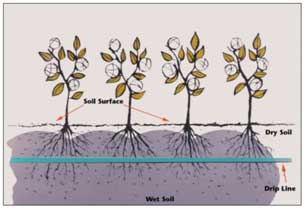
A research study of six systems with application efficiencyranging from 60 to 97 percent, it was found that those with the highest applicationefficiencies tend to have the lowest pumping costs. Of thesix irrigation systems, the least efficient was the conventionalfurrow system; the most efficient was the subsurface drip irrigation system.
|
IRRIGATION
|
|
 The use of irrigation water depends on: