|

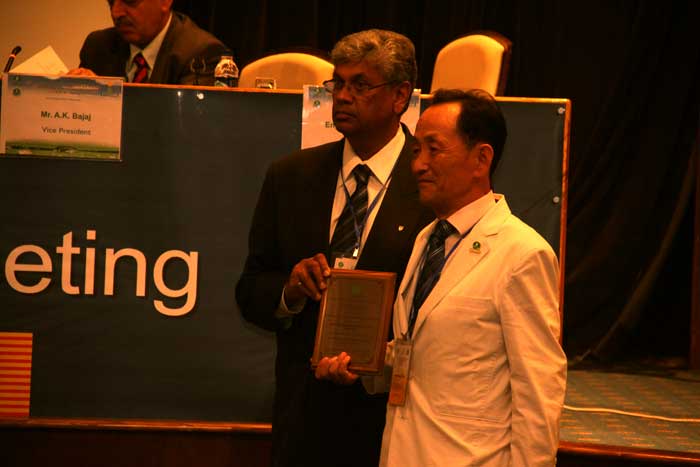
CNCID representative receiving WatSave Technology Award 2012 from President Gao Zhanyi and Mr. Ian Atkinson (IAL) |
SPONSORS
- 2012 - IACID, Irrigation Australia’s Committee on Irrigation & Drainage
- 2011 - Iranian National Committee on Irrigation
and Drainage (IRNCID)
- 2010 - Indonesian National Committee of ICID (INACID) & Chinese National Committee on Irrigation and Drainage (CNCID)
- 2009 - Indian National Committee on Irrigation
and Drainage (INCID)
- 2008 - Pakistan National Committee on Irrigation and Drainage (PANCID)
- 2007 - U.S. National Committee on Irrigation and Drainage (USCID)
- 2006 - Malaysian National Committee on Irrigation and Drainage (MANCID),
and Spanish
National Committee on Irrigation and Drainage (CERYD)
- 2005 - Spanish National Committee on Irrigation and Drainage (CERYD)
- 2004 - French National Committee on Irrigation and Drainage (AFEID)
- 2003 - Japanese National Committee on Irrigation and Drainage (JNC-ICID)
- 2002 - Canadian National Committee on Irrigation and Drainage (CANCID)
- 2001 - Korean National Committee on Irrigation and Drainage (KCID)
- 2000 - Indian National Committee on Irrigation and Drainage (INCID)
- 1999 - Chinese National Committee on Irrigation and Drainage (CNCID)
- 1998 - Netherlands National Committee on Irrigation and Drainage (NETHCID),
Directorate General of Public Works & Water Management, and IHE
Delft
|
The International
Commission on Irrigation and Drainage (ICID) decided at its 48th meeting in
Oxford, UK to institute the ICID WatSave Annual Award(s). Since then the award(s)
have been presented each year to an individual or a team. It is ICID's aim to
award the Annual Watsave Awards for the recognition of outstanding contributions to water conservation or water saving and thereby to create an ICID-wide culture
of water savings for the benefit of all water-users. Therefore, the Awards are
only made in respect of actual realised savings and not for promising
research results, plans and/or good ideas/intentions to save water. There are
four categories of awards viz.:
|
WatSave
Awards - 2013 : Invitation for Nominations
|
Watsave Awards 2013 - Invitation for Nominations
ICID is inviting nominations for the WatSave Awards 2013 from across the world to recognize outstanding contributions to water saving/conservation in agriculture. The Awards are given in the following four categories –
- WatSave Technology Award
- WatSave Innovative Water Management Award
- WatSave Young Professionals Award
- WatSave Farmer Award
The WatSave Awards will be presented during the 1st World Irrigation Forum and 64th meeting of the IEC scheduled to be held from 29 September to 05 October 2013 at Mardin, Turkey.
Nominations are invited for the ‘WatSave Awards 2013’ from individuals/ team of individuals through ICID National Committees/ Committee. The entries are open to all professionals/ teams from ICID member countries as well as non-member countries. In case of an entry from a ‘non-member’ country, the nomination has to be routed through and validated by an active National Committee of ICID, who should be in touch with the nominee and is aware of nominee’s work’.
All the National Committees/ Committee are requested to send their nominations by inviting contributions on outstanding achievements from all those professionals/ farmers who are engaged in water saving/ conservation activities. The deadline for receipt of the entries from the National Committees along with a completed Nomination Form (Annex 1) to the Central Office ICID, New Delhi is 31 May 2013. The ‘Conditions and Criteria’ set for the awards are given in Annex 2. Annex 3 shows the checklist of enclosures to be forwarded by the National Committee while submitting the nomination(s).
The national committees/ committee are requested to carry out primary evaluation of the nomination(s) in light of the questions posed in the evaluation process, and submit only one of them in any particular category (if there were more responses) to the Central Office, New Delhi. Nominations not complying with the above requirements or more than one nomination from the same National Committee in a particular category are liable to be rejected.
Full details of the awards and excerpts of the past award winning contributions are available on ICID website www.icid.org/awards.html.
Contact: Dr. Vijay K. Labhsetwar, Director, ICID, New Delhi (e-mail: icid@icid.org)
|
Previous
Award Winners
Innovative Water Management Award
Mr. Peter McCamish, Australia (2012) [Award winning paper in PDF
format]
Prof. Dr. Subhash Madhawrao Taley, India (2011) [Award winning paper in PDF
format]
Mr. Kobus Harbron, South Africa(2010) [Award winning paper in PDF
format]
Messrs Shahaji Manikrao Somawanshi, Bharat Kawale and Sanjay Madhukar Belsare,
India (2009) [Award
winning paper in PDF format]
Dr. Yousri Ibrahim Atta, Egypt (2008) [Award
winning paper in PDF format]
Dr. Abraham Singels, South
Africa (2007) [Award
winning paper in PDF format]
Dr.
Nico Benadé, South Africa (2006) [Award winning paper in PDF format]
Prof. Li Daixin, China (2005) [Award winning paper
in PDF format]
Er. Suresh. V. Sodal, India (2004) [Award winning paper
in PDF format]
Dr. Muhammad Akram Kahlown, Pakistan (2003) [Award winning
paper in PDF format]
Dr. Mahmoud Moustafa, Egypt (2002) [Award winning paper
in PDF format]
Prof. Gu Yuping, China (2001) [Award winning paper in
PDF format]
Dr. Francisco del Amor Garcia, Spain (2000) [Award winning
paper in PDF format]
Eng. Hussein El-Atfy, Egypt (1999) [Award winning paper
in PDF format]
Prof. Wu Xijin, China (1998) [Award winning paper in
PDF format]
Technology
Award
Prof. Peng Shizhang, China (2012) [Award winning paper in PDF
format]
Messrs Pieter S van Heerden and Charles T Crosby, South Africa (2011) [Award winning paper in PDF
format]
Dr. Keith Weatherhead, Mr. Melvyn Kay and Dr. Jerry Knox, UK (2010) [Award winning paper in PDF
format]
Prof. Dr. Rai
Niaz Ahmad, Pakistan (2009) [Award winning paper in PDF
format]
Dr. Yella Reddy, Mr.
Satyanarayana and Mrs.G Andal, India (2008) [Award
winning paper in PDF format]
Messrs Werner and Herbert Arns, Brazil (2007) [Award
winning paper in PDF format]
Prof. Kang Shaozhong, China (2006) [Award
winning paper in PDF format]
Mr. Omar Redjepow, Turkmenistan (2004) [Award
winning paper in PDF format]
Dr. Richard John Stirzaker (2003) [Award winning paper
in PDF format]
Mr. Robert E. Merry, UK (2002) [Award winning
paper in PDF format]
Prof. Tai Cheol Kim, Korea (2001) [Award winning paper
in PDF format]
Prof. Mao Zhi, China (2000) [Award winning paper in PDF
format]
Young
Professionals Award
Dr.
Malcolm Gillies, Australia (2009) [Award
winning paper in PDF format]
Dr. Amgad Elmahdi, Australia (2008) [Award
winning paper in PDF format]
Ms. Neelam Patel, India (2006)
[Award winning paper in PDF format]
Dr. Mohamed Maher Mohamed Ibrahim, Egypt (2005) [Award
winning paper in PDF format]
Dr. Juan Antonio Rodriguez Diaz, Spain (2004) [Award
winning paper in PDF format]
Mr. Tony L. Wahl, USA (2003) [Award winning paper in
PDF format]
Dr. Ashutosh Upadhyaya, India (2002) [Award winning paper
in PDF format]
Er. Sanjay M. Belsare, India (2001) [Award winning
paper in PDF format]
Mr. Gao Zhanyi, China (1999) [Award winning paper in
PDF format]
Farmer Award
Mr. Jerry Erstrom, USA (2011) [Award winning paper in
PDF format]
Mr. Arvind Narayanrao Nalkande, India (2009) [Rainwater conservation through natural cracks in deep black soils]
N.D.
Gulhati Memorial Lecture for International Cooperation in Irrigation and
Drainage |
Triennially,
N.D. Gulhati Memorial International Lecture is delivered by an eminent professional
at the time of Congresses.
Eighth
N.D. Gulhati Memorial Lecture for International Cooperation In Irrigation
and Drainage

The Irrigation Sector Shift from Construction to Modernization: What is Required for Success?
Dr. Charles Michael Burt (USA)
Download (Full version)
PowerPoint Presentation
Presented
at ICID’s 21st Congress, Tehran, Iran
October 2011 |
Seventh N.D.
Gulhati Memorial Lecture for International Cooperation In Irrigation and Drainage
Irrigation in the Context of Today's Global Food Crisis
Vice President Hon. Chandra A. Madramootoo (Canada)
Presented at ICID’s 20th Congress, Lahore, Pakistan
October 2008
Seventh
N.D. Gulhati Memorial Lecture for International Cooperation In Irrigation
and Drainage

IRRIGATION
IN THE CONTEXT OF TODAY'S GLOBAL FOOD CRISIS
Vice President Hon. Chandra A. Madramootoo (Canada)
The
7th N.D. Gulhati Memorial Lecture for International Cooperation in Irrigation
and drainage was delivered by VPH Chandra Madramootoo at Lahore Congress.
The lecture provided an overview of the challenges facing irrigation and
drainage community, and the need to better manage our irrigation and drainage
systems to reduce poverty and hunger. The following is a summary of some
key aspects of his presentation.
Global Irrigation
Development
Of the 1500 million
ha of global crop land about 277 million ha (18%) are irrigated. The largest
share of the irrigated area is in Asian region (70%), followed by North
and Central America (11%), Europe (9%), Africa (5%), South America (4%),
and Oceania (1%). During the last four decades the crop land has increased
marginally, while population has more than doubled leading to a reduction
in the area of land needed to produce food for a person. Irrigation has
played an important role in increasing crop productivity. However, the
rate of irrigation expansion has declined from 2.3% in 1970-80 to 0.6%
in 2000-05 (see figure). Some countries will increasingly face water scarcity.
Future needs of water for food are huge and improved water management
systems will be required to cope with the demand.
Global Food situation
During the last four
decades the crop area harvested has hardly increased, while the world
cereal production has increased by about two and half fold. In general,
the overall food prices (in USD) are up by 75% since 2000. Cereals, in
particular rice and wheat dominate food supply and provide the largest
share of energy to the world's population. However, globally, close to
one billion people still remain malnourished, of which some 800 million
live in least developed countries (LDCs). The Millennium Development Goals
(MDGs) has targeted to reduce this number by half by 2015. In fact the
preliminary goal of MDG attempts to highlight this given its importance.
This translates into a need of reducing 22 million per year, while current
rate is only 6 million per year - posing a big challenge to bridge the
gap between the target and achievement.
There are contradictory
views as regards the impact of increasing bio-fuel crop production on
food availability. Some view that this might cause food shortage and consequent
hike in the food prices; while a few others opine that bio-fuels provide
LDCs and poor farmers new opportunities for employment to improve their
economy and livelihoods.
On-farm Water Management
and System Modernization
There has been growing
concerns over declining irrigation system performance and investment benefits,
especially in the large-scale public irrigation schemes. Improvement in
both viz., conveyance efficiency and on- farm water management is a key
for increasing the overall irrigation efficiency. Efficiency gains of
14% in gross withdrawal can also be achieved through reuse of return flows.
Improved surface irrigation methods like level furrows, sprinkler and
micro irrigation methods and use of advanced techniques of irrigation
scheduling can help improve on-farm water management. Modernization of
irrigation and drainage systems in a broad sense (technical, management,
financial, environmental) will be required at a large-scale, especially
in emerging countries to achieve the required increase in food production,
and also, in some cases, to save water for other uses.
Investment in Agriculture
It is seen that the
public spending on agriculture is the lowest in the agriculture based
countries, while the share of agriculture in GDP is the highest. National
and international investments in agriculture, official development assistance
(ODA), and the World Bank's lending in irrigation have been declining
steadily and a complacency set in that is a major cause of the recent
global food shortage.
The Way forward
In most developing
countries, the agricultural sector is considered as an engine of growth
and national governments therefore should reinvest in agriculture and
associated infrastructure. In order to reduce water withdrawals for irrigation,
upgrading of irrigation infrastructure through rehabilitation and modernization
should be given priority. Other aspects like timely maintenance of irrigation
and drainage infrastructure, investment in water storage and water saving
technologies, combating the twin menace of waterlogging and salinity through
drainage are required. Public-private investment in infrastructure is
to be encouraged. One size does not fit all, and solutions have to be
case specific.
Maximizing basin water
productivity through multi-objective decision making process, developing
a rapid innovative research agenda, capacity building at all levels and
building of institutional support for local, regional and international
markets will go a long way in achieving food security. External factors,
like impacts of bio-fuel production, climate change, virtual water trade,
changes in agriculture markets and the prices of commodities will influence
agriculture growth and allied activities. Such changes will require additional
adaptations in the development of water management measures to sustain
global food production to desired levels and avoid the probability of
a severe crisis in the coming years.
PowerPoint
Presentation
Presented
at ICID’s 20th Congress, Lahore, Pakistan
October 2008 |
Sixth N.D.
Gulhati Memorial Lecture for International Cooperation In Irrigation and Drainage
A Process-Based Approach to Improving the Performance
of Irrigated Agriculture
Dr. Albert J. Clemmens (USA)
Presented at ICID’s 19th Congress, Beijing, China
September 2005
1999
prize-winning paper in PDF format
Best
Performing Workbody Awar (BPWA) |
| |
3rd
Best Performing Workbody Award, 2011 |
ICID in 2003 instituted the Best Performing Workbody Award (BPWA) to be presented triennially at the time of ICID Congress, based on the various facets demonstrated by the workbodies in between two Congresses. The first Award was presented at the 19th ICID Congress held in Beijing in September 2005 to Working Group on History of Irrigation, Drainage and Flood Control (WG-HIST), second Award was presented to ICID Journal Editorial Board (EB-JOUR) at the 20th ICID Congress held in Lahore in 2008, and third Award was presented to Working Group on Sustainable
Development of Tidal Areas (WG-SDTA) at the 21st ICID Congress held in Tehran in 2011, for their excellent performance, impressive achievements and outstanding contribution.
Proposals are invited for the 4th Best Performing Workbody Award (BPWA-4) to be presented during the 22nd ICID Congress in Korea in 2014. The Award will be in the form of
- Citation / Certificate / Plaque to each member of the Workbody (as per the latest membership composition) and publicizing the Award winning WG through a webpage on the ICID website giving achievements of the Workbody and personal profile of each member.
- Free publications of decided value to each member of the WG.
The formal proposals should be sent for consideration with all requisite information and supported by relevant documents, for evaluation by the Panel of Judges. The last date of receipt of nominations from ICID Working Groups / Committees is 2014. |
| |
3rd
Best Performing Workbody Award, 2011 |
 The 3rd Best Performing Workbody Award (BPWA) was presented to the ICID Working Group on Sustainable
Development of Tidal Areas (WG-SDTA).
The performance of a workbody is adjudged based upon a set of criteria
and its contribution towards the mandate and mission of ICID. The Award was presented to Dr. Park Sang Hyun (Korea), Chairman,
WG-SDTA by the President Chandra Madramootoo on the
occasion of the 62nd IEC and 21st ICID Congress held at Tehran, Iran, October 2011. The 3rd Best Performing Workbody Award (BPWA) was presented to the ICID Working Group on Sustainable
Development of Tidal Areas (WG-SDTA).
The performance of a workbody is adjudged based upon a set of criteria
and its contribution towards the mandate and mission of ICID. The Award was presented to Dr. Park Sang Hyun (Korea), Chairman,
WG-SDTA by the President Chandra Madramootoo on the
occasion of the 62nd IEC and 21st ICID Congress held at Tehran, Iran, October 2011.
|
2nd
Best Performing Workbody Award, 2008 |
 The
Best Performing Workbody Award (BPWA) was instituted by ICID in 2002.
The performance of a workbody is adjudged based upon a set of criteria
and its contribution towards the mandate and mission of ICID. The BPWA
2008 was presented to the ICID Journal Editorial
Board (EB-JOUR) by the Governor of Punjab on 17 October 2008 on the
occasion of the 59th IEC and 20th ICID Congress held at Lahore, Pakistan. The
Best Performing Workbody Award (BPWA) was instituted by ICID in 2002.
The performance of a workbody is adjudged based upon a set of criteria
and its contribution towards the mandate and mission of ICID. The BPWA
2008 was presented to the ICID Journal Editorial
Board (EB-JOUR) by the Governor of Punjab on 17 October 2008 on the
occasion of the 59th IEC and 20th ICID Congress held at Lahore, Pakistan.
 ICID
Journal acts as a mouthpiece to communicate to the international water
community ICID's sixty years of experience in the promotion and transfer
of water and land management technology and related issues. ICID Journal
was granted Science Citation Index Expanded (SCIE) starting with Vol.49,
Issue No.1 of 2000 which was the first issue of the quarterly Journal
printed and distributed under ISSN 0971-7412. ICID Journal was also selected
for coverage in Current Contents/Agriculture, Biology and Environmental
Sciences (CC/AB&ES). ICID
Journal acts as a mouthpiece to communicate to the international water
community ICID's sixty years of experience in the promotion and transfer
of water and land management technology and related issues. ICID Journal
was granted Science Citation Index Expanded (SCIE) starting with Vol.49,
Issue No.1 of 2000 which was the first issue of the quarterly Journal
printed and distributed under ISSN 0971-7412. ICID Journal was also selected
for coverage in Current Contents/Agriculture, Biology and Environmental
Sciences (CC/AB&ES).
|
1st
Best Performing Workbody Award |
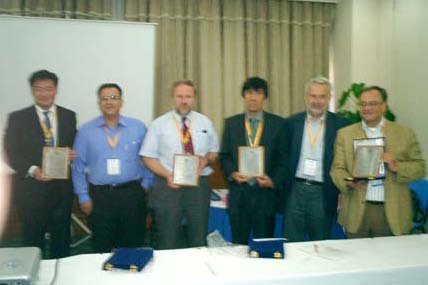 The
Best Performing Workbody Award (BPWA) was instituted in 2003 to recognize
the performance of workbodies between the two Congresses. The first such
award has been given to Working
Group on History of Irrigation, Drainage and Flood Control (WG-HIST). The
Best Performing Workbody Award (BPWA) was instituted in 2003 to recognize
the performance of workbodies between the two Congresses. The first such
award has been given to Working
Group on History of Irrigation, Drainage and Flood Control (WG-HIST).
The WG-HIST
was established in 1980. The Group has published more than 30 volumes
of Water History related documents and books, including Historical Dams
(ICID 2001), The Danube Valley (ICID 2004), The Indus Basin (ICID 2004),
"A History of Water Issues" (UNU 2005), and History of Irrigation
and Drainage of various member countries. |
| |
| ICID
has instituted the 'Best Paper Award' in 2006 in recognition of the outstanding
paper contributed to Irrigation and Drainage, the Journal of ICID. Annually,
starting on the occasion of the 57th IEC meeting (2006) in Kuala Lumpur,
an award will be given to the best paper published in the issues of the
Journal in the preceding year (January-December). Decision on the best paper
will be made by the Editor in consultation with the Associate Editors. The
award will be a citation plaque and Gift Books from M/s. John Wiley &
Sons Ltd. (UK). |
|
Zahra Paydar, Freeman Cook, Emmanuel Xevi, and Keith Bristow (Australia) received 'Best Paper Award 2012' for their outstanding paper titled "An Overview of Irrigation Mosaics" published in Volume 60, No.4. |
|
VPH Stephens receiving ‘Best Paper Award
2011’ from President Chandra Madramootoo in recognition of the outstanding paper titled "Airborne Remote Sensing for Detection of Irrigation Canal Leakage"
by Yanbo Huang, Guy Fipps, Stephan J. Maas, and Reginald S. Fletcher (USA) published in Volume 59, No. 5. |
|
VPH Vidal receiving ‘Best Paper Award
2010’ from President Chandra Madramootoo in recognition of their outstanding paper titled "Farmers' perceptions and engineering approach in the modernization of a community-managed irrigation scheme. A case study from an oasis of the Nefzawa (South of Tunisia)", by W. Ghazouani, S. Marlet, Mekki and A. Vidal, published in Volume 58, No. S3
|
|
Mrs.
Jianxin Mu, Mr. Shahbaz Khan and Dr. Zhanyi Gao receiving ‘Best
Paper Award 2009’ from President Chandra Madramootoo in recognition
of their outstanding paper titled “Integrated
Water Assessment Model for Water Budgeting Under Future Development Scenarios
in Qiantang River Basin of China” published in Volume 57, No.4. |
| |
Dr.
L.K. Smedema (The Netherlands) received 'Best Paper Award 2008'
for his outstanding paper titled "Revisiting
currently applied pipe drain depths for waterlogging and salinity control
of irrigated land in the (semi) arid zone" published in Volume
56, No. 4.
Drs.
S. Khan, S. Mushtaq, Y. Luo, D. Dawe, M. Hafeez, and T. Rana received
'Best Paper Award 2008' for their outstanding paper titled "Conjunctive
Water Management Options: Examples from Economic Assessment of System-level
Water Saving through Liuyuankou Irrigation System, China" published in Volume 56, No. 5. |
|
Dr.
G R Backeberg (South Africa) receiving ‘Best Paper Award
2007’ from President Lee in recognition of his outstanding paper titled
“Reform
of User Charges, Market Pricing and Management of Water: Problem or Opportunity
for Irrigated Agriculture” published in Volume 55, No.1. |
|
Dr.
T.B.S. Rajput and Dr. Neelam Patel (India) receiving 'Best
Paper Award 2006' from President Lee in recognition of their outstanding
paper titled "Enhancement
of Field Water Use Efficiency in the Indo-Gangetic Plain of India"
published in Issue 54.2. |
Best
Performing ICID National Committee Award (BPNCA)
|
ICID in 2002 instituted
an Award to recognize the Best Performing National Committee (BPNC). The
award is presented at every triennial Congress. The performance of a National
Committee is judged on the basis of various facets demonstrated by the
participating National Committees between two successive ICID Congresses
(over a three year period). The award consists of a shield and a citation
plaque.
|
|
South African
National Committee on Irrigation and Drainage (SANCID) has won the 4th BPNC Award. The award was received by VPH Felix Britz Reinders from President Chandra Madramootoo on the occasion of the 62nd IEC and 21st ICID
Congress held at Tehran, Iran, October 2011.
|
|
Iranian
National Committee on Irrigation and Drainage (IRNCID) has won the 3rd BPNC Award. The award was presented to IRNCID by the Governor
of Punjab on 17 October 2008 on the occasion of the 59th IEC and 20th ICID
Congress held at Lahore, Pakistan. |
|
Egyptian
National Committee on Irrigation and Drainage (ENCID) won the second Award for Best Performing ICID National Committee at 19th
ICID Congress, Beijing, China, September 2005. |
|
Korean
National Committee of ICID (KCID) won the first Award for Best Performing ICID National Committee at 18th
ICID Congress, Montreal, Canada, July 2002. |
Dr.
Hassan Ismail Memorial International Award (Discontinued) |
The
Dr. Hassan M. Ismail Memorial International Award has
been established with effect from the 16th ICID Congress at Cairo
in 1996 to be awarded to a young professional for the best paper on the development
of irrigation, drainage and flood control in Africa, submitted to an ICID congress
or ICID's Afro-Asian Regional Conference or an African Conference.
The award is made from the proceeds
of a fund established by the Egyptian National Committee with donations from
the family of Dr. Hassan Ismail and his admirers.
2002
prize-winning paper in PDF format
2001
prize-winning paper in PDF format
2000
prize-winning paper in PDF format
1999
prize-winning paper in PDF format
|


